What Is White Label SEO – How It Works, Importance, Benefits


White Label SEO is the practice where one company offers search engine optimisation services to another company to sell them as their own. It is a kind of having a hidden SEO team operating behind the scenes, whilst your agency gets all the glory.
Consider that you are a digital marketing agency that specializes in social media or web design. One client abruptly inquires, Could you do my SEO also? Rather than replying no or rushing to find specialists, you just collaborate with a White Label SEO company that takes care of all the heavy lifting, including research on keywords and link building, and presents the result under your brand name.
This model helps agencies grow fast without building a full in-house SEO department. In today’s competitive digital market, White Label SEO is the shortcut to scaling smarter, not harder.
Key Highlights
- White Label SEO lets agencies resell SEO services done by expert partners under their own brand
- It helps agencies scale fast without hiring full-time SEO teams
- Major tasks include audits, keyword research, content, link building, and reporting
- Delivers cost savings, faster turnaround, and consistent results
- Quality control, communication, and niche mismatch are the main challenges, solved by testing and audits
- Always keep backup partners to avoid overdependence
- Use white label SEO tools and platforms for seamless client reporting
- Local businesses benefit greatly from white label local SEO services
- Strong partner selection ensures transparency and brand consistency
- Ultimately, White Label SEO boosts growth while you focus on clients, not execution
How Does White Label SEO Actually Work?

Here’s the simple workflow most agencies follow:
- Your agency signs a client. You discuss goals, collect website data, and set expectations.
- You forward the project to your White Label SEO provider. They perform the keyword research, content strategy, on-page optimisation, link building, and reporting.
- The provider delivers reports and results to you. You rebrand these as your own and present them to your client.
- You manage the relationship and profits. The client thinks it’s all done by your internal team, seamless and professional.
That’s the beauty of White Label SEO: execution without the operational chaos.
Why Is White Label SEO So Important for Agencies Today?
The truth is, clients today want full-stack solutions. If your agency can’t deliver SEO, they’ll find someone who can. White Label SEO bridges that gap instantly.
With white label seo services, you can:
- Offer complete marketing packages without hiring a large team
- Focus on client acquisition while experts handle the SEO
- Improve delivery speed and client satisfaction
- Generate consistent recurring revenue
For agencies in India, this model is especially powerful. Labour, tool costs, and training time are significant; outsourcing SEO to trusted partners helps you expand your offering and retain clients for longer.
White Label SEO vs In-House SEO: Which Model Fits Your Agency?
In-house SEO sounds great, but then reality sets in. Skilled professionals must be recruited, salaries paid, tool management, and Google updates constantly followed. All this very quickly consumes a lot of money and time. This is where, in 2027, white label SEO becomes the smarter alternative for many agencies.
An in-house SEO team means total control, but at the same time, it means fixed costs and limited scalability. During the time of high demand, your team has a hard time keeping up. When demand is low, the staff keeps sitting idle.
On the other hand, white label SEO provides the agency with flexibility. The campaigns can be increased or decreased without any long-term commitment, which is very important for an unpredictable market.
The depth of expertise is another main factor that distinguishes the two models. Technical optimization, content strategy, AI-assisted audits, link quality evaluation, and performance monitoring are already the core elements of an SEO professional’s work.
Even if you have the required knowledge, building up an in-house team will still be a challenge. A good white label partner has already got the specialized staff for each function, ensuring consistent execution across all functions.
From a growth standpoint, the agencies that deal in white label SEO services usually grow at a faster pace because the time that would have been spent on operational management is now being channeled towards client acquisition.
The decision is not which model is “better” but rather which one is able to support sustainable growth. Small and midsize agencies in most cases are able to tap into the benefits of speed, expertise, and profitability at the same time avoiding operational stress by opting for white labeling.
What Are the Core Components of a White Label SEO Setup?
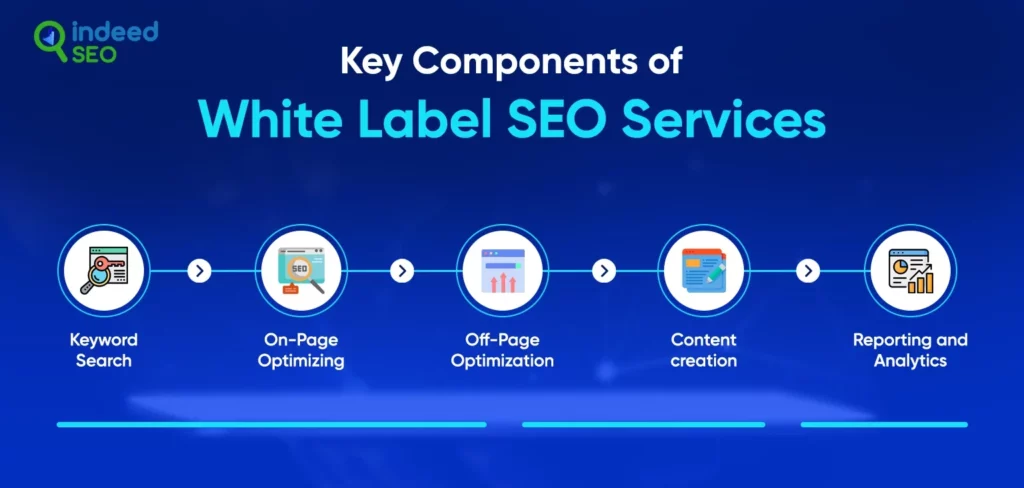
A good White Label SEO setup covers every part of SEO, including:
- Website and technical audits
- Keyword research and content planning
- On-page optimisation (meta tags, headings, internal links, schema)
- Content creation and optimisation
- Link building and outreach
- Analytics and reporting
Each of these elements is essential, and a reliable partner ensures that they’re done at an expert level.
How White Label SEO Audits Set the Foundation for Long-Term Results
Every successful SEO campaign starts with clarity, and that clarity comes from a strong white label SEO audit. Before rankings improve or traffic grows, agencies must understand what’s broken, what’s missing, and what opportunities exist.
A professional audit evaluates technical health, on-page structure, content quality, backlink profiles, and competitor positioning. In 2027, audits also assess Core Web Vitals, mobile-first indexing, and AI-generated content risks. Without this foundation, optimisation efforts are guesswork.
For agencies, white label SEO audits offer immediate value. They help onboard clients smoothly, set realistic expectations, and create data-backed roadmaps. Clients appreciate transparency, especially when audits clearly explain issues and prioritise fixes rather than overwhelming them with jargon.Strong audits also protect agency credibility.
When your white label SEO services begin with a thorough assessment, it reduces the risk of missed issues that could delay results later. More importantly, audits create alignment between the agency, the provider, and the client. Everyone knows the starting point and the path forward. That alignment is what turns SEO from a short-term experiment into a long-term growth channel.
What Does a White Label SEO Partner Deliver?
A solid white label seo company gives you everything needed to impress your clients. Typically, they handle:
- Full white label seo audit reports
- Keyword and content strategies
- On-page optimisation and content edits
- Link-building campaigns
- Monthly progress tracking and updates
Your job? Branding those deliverables, adding your client-specific insights, and presenting them confidently.
In short, they provide the muscle; you bring the relationship and strategy.
What Are the Biggest Benefits of Using White Label SEO?
1. You Save Time and Money
Hiring a full SEO team means salaries, tools, training, and management. A White Label SEO model removes all that overhead. You only pay for the work you need — no idle costs, no extra employees.
2. You Get Expert Execution
Experienced SEO professionals handle your client campaigns. They know Google’s algorithms, how to avoid penalties, and how to generate real growth.
3. You Scale Effortlessly
Whether you have 5 clients or 50, your partner can handle the load. That means you can take on new business without worrying about delivery delays.
4. You Strengthen Your Brand
The client sees your reports, your logo, and your communication. Behind the curtain, your partner does the work, but your agency gets the praise.
5. You Focus on What Matters
You don’t have to juggle keyword density or crawl errors. Instead, you focus on client relationships, upselling, and growth.
What Are the Challenges of White Label SEO and How Can You Avoid Them?
Every good model has its flaws. The key is awareness and prevention.
1. Quality Control Issues
Sometimes, providers may deliver generic, templated content or low-quality backlinks that don’t align with your client’s goals. This can damage your brand reputation if you pass it on blindly.
The fix is simple: always start with a pilot project. Test their process, assess the deliverables, and review their keyword strategy and link-building quality before signing a long-term deal. Once you’re confident, scale the partnership gradually while maintaining periodic audits to ensure standards never slip.
2. Communication Gaps
When communication is slow or unclear, project timelines stretch, and clients start losing trust. A missed update or delayed reply can snowball into frustration. Choose a provider with clear communication channels, ideally one that assigns a dedicated account manager.
Schedule weekly check-ins and set clear SLAs for responses. Remember, seamless coordination between your team and the provider keeps the client experience smooth and professional.
3. Mismatched Strategy
Every industry demands a unique SEO approach. A strategy that works for an e-commerce brand won’t fit a law firm or a real estate agency. Not every provider understands this, which leads to cookie-cutter campaigns.
Before committing, ensure your partner invests time in industry research and tailors their strategy for each client. Ask for sample plans or case studies from similar sectors; it’s the easiest way to confirm whether they can adapt.
4. Overdependence on One Partner
Relying on a single provider can be risky. If they face internal issues, delays, or quality drops, your entire client pipeline suffers. Always have backup providers in place, even if you use them occasionally, so you’re never stuck.
Diversifying your partnerships not only reduces risk but also gives you the flexibility to match specific providers to certain project types or niches.
Handle these issues early, and White Label SEO becomes a friction-free engine for agency growth.
How to Choose the Right White Label SEO Company
When selecting your partner, consider these factors:
- Reputation: Check reviews, testimonials, and past projects.
- Transparency: They should share deliverables, not hide behind jargon.
- Scalability: Ensure they can grow with your agency.
- Technology: The best ones use automation and analytics for accurate reporting.
- Support: Fast replies, clear communication, and reliability are musts.
Don’t settle for the cheapest provider. Choose one that understands your market, your clients, and your voice.
What Tools and Reports Are Used in White Label SEO?
In the background, most partners use powerful white label seo tools and analytics dashboards to run audits, track rankings, and generate client reports.
As an agency, you’ll receive detailed white label seo reports showing keyword growth, backlinks, and traffic metrics. You can rebrand these to reflect your agency identity before sharing them.
Some even use automated white label seo software or a white label seo platform that integrates directly with Google Analytics and Search Console, so you can monitor performance anytime.
Remember, data builds trust. When clients see well-presented reports, they see results, and results mean renewals.
How to Present White Label SEO Reports That Clients Actually Understand
Data alone doesn’t impress clients, clarity does. Well-structured white label SEO reports turn raw metrics into meaningful insights. In 2027, clients expect reports that explain impact, not just rankings.
A strong report connects SEO actions to business outcomes. Traffic growth, conversions, and visibility improvements should be clearly tied to the work done. The best white label SEO reports use simple language, visuals, and comparisons over time to tell a story.
Agencies that personalise reports with client-specific insights build trust faster. Even when results take time, transparent reporting reassures clients that progress is happening.
This is where white labeling excels, providers deliver detailed data, and agencies translate it into value. Ultimately, reporting isn’t just a deliverable; it’s a retention tool. Agencies that master reporting keep clients longer and reduce churn.
How to Integrate White Label SEO in Your Agency’s Offerings
If you already offer digital marketing, PPC, or web design, adding SEO is a natural next step. Here’s how you can blend it smoothly:
- Start with audits. Offer a free or discounted SEO audit to warm up leads.
- Create bundled packages. Combine SEO with social media or paid ads.
- Promote results. Showcase traffic growth and conversions from current clients.
- Educate clients. Share simplified reports so they understand ROI.
White Label SEO for agency setups works best when you focus on the relationship while your partner focuses on performance.
How Do White Label SEO Programs Work?
Many providers offer structured white label seo programs designed specifically for agencies. These include ready-made service packages, monthly deliverables, and reporting dashboards you can brand.
You can pick from standard SEO, content-focused plans, or link-building-only programs. Choose what fits your client base best.
These programs are flexible, scale up when you have new clients, and scale down when you don’t. It’s SEO on demand.
What About Local SEO? Can That Be White Labeled Too?
Absolutely. If your clients are local businesses like cafés, salons, or law firms, white label local seo services can make a huge difference.
A local SEO partner can handle:
- Google Business Profile optimisation
- Local citations and directory listings
- Local link building
- Reviews and reputation management
- Geo-targeted keyword optimisation
This helps small businesses dominate their neighbourhood searches while you keep your agency as their single trusted contact.
White Label SEO for Ecommerce Brands: A Missed Opportunity for Many Agencies
Many agencies focus heavily on local businesses but overlook ecommerce, where white label SEO can deliver massive returns. Ecommerce SEO requires specialised knowledge, site architecture, product indexing, faceted navigation, and conversion-focused optimisation, which many agencies lack internally.
This is where white label SEO services shine. A specialised partner can handle category optimisation, product page enhancements, structured data, and scalable content strategies without burdening your team. For ecommerce clients, results compound over time, leading to higher lifetime value and longer retainers.
In 2027, ecommerce SEO is more competitive than ever due to marketplace dominance and AI-driven search experiences. Agencies offering ecommerce-ready white label SEO services position themselves as growth partners, not just vendors. This opens doors to larger contracts and international clients.
By adding ecommerce-focused SEO through white labeling, agencies expand vertically without operational risk. It’s one of the fastest ways to increase revenue while maintaining delivery quality.
How Do You Price White Label SEO Services for Clients?
Pricing depends on how you structure your offer:
- Cost-plus model: You add a markup over the partner’s price.
- Package model: You create fixed plans from basic, standard, and premium option.
- Custom pricing: Tailor the quote to each client’s goals and budget.
Always include reporting, strategy calls, and ongoing optimisation in your pricing. That’s what makes your service feel premium.
How to Ensure Quality and Transparency
Here’s how top agencies maintain standards:
- Review every white label seo report before sending it to the client
- Use consistent branding and messaging
- Audit deliverables regularly, especially links and content
- Keep communication open with both client and partner
- Document all processes
When you maintain this structure, you’ll rarely face client complaints or service gaps.
What Results Can You Expect with White Label SEO?
With consistent collaboration and proper execution, you can expect:
- Higher client retention (because they see tangible results)
- Lower overhead costs
- Faster onboarding of new clients
- Improved brand reputation
- Predictable recurring revenue
Most agencies see ROI within the first few months of running their White Label SEO model because margins are healthier, and delivery time is shorter.
What Mistakes Should You Avoid in White Label SEO?
- Choosing a partner without research. Always vet them.
- Not reviewing content or backlinks. Quality matters more than speed.
- Overpromising results. SEO takes time — manage client expectations.
- Ignoring analytics. If you don’t track performance, you can’t improve.
- Lack of transparency. Clients appreciate honesty more than perfection.
Avoiding these mistakes ensures your clients trust you long term.
The Future of White Label SEO
The demand for outsourced SEO is growing fast, especially with the rise of automation and AI-driven analysis. But don’t think of it as a short-term hack; it’s a sustainable growth model.
More agencies now rely on White Label SEO to expand services, build recurring income, and deliver measurable results at scale. With better white label seo software and smarter white label seo platforms, the process will only become smoother.
Agencies that adapt early gain huge advantages like lower costs, more clients, and stronger branding.
The Role of AI and Automation in White Label SEO (2027 Outlook)
By 2027, AI is no longer optional in SEO, it’s foundational. Modern white label SEO providers increasingly rely on AI-driven tools to improve accuracy, speed, and decision-making across campaigns. This doesn’t replace human strategy; it enhances it.
AI-powered white label SEO audits now identify technical issues, crawl inefficiencies, and content gaps faster than manual reviews. Machine learning models analyse ranking patterns, competitor movements, and keyword volatility to guide smarter optimisation strategies. This allows agencies to deliver better outcomes without increasing turnaround time.
Automation also plays a major role in reporting. Advanced white label SEO reports automatically pull data from analytics platforms, ranking trackers, and backlink tools, presenting insights in a clean, client-ready format. This reduces errors and ensures consistent reporting cycles, which clients expect in 2027.
Importantly, AI improves scalability. Agencies managing dozens of clients can rely on automated workflows for routine tasks while focusing on strategy and relationships.
When evaluating white label SEO services, agencies should assess how well the provider integrates AI responsibly, balancing automation with expert oversight. Those who adopt this hybrid approach stay competitive, efficient, and profitable in an increasingly data-driven SEO landscape.
Final Thoughts
White Label SEO isn’t just a tactic; it’s a long-term growth strategy. It allows you to:
- Focus on sales and relationships
- Deliver top-notch SEO without hiring an army
- Scale your agency faster and smarter
When you choose the right partner and maintain quality control, this model transforms your business from a small agency into a scalable powerhouse.
Remember, clients don’t care who did the work; they care about results. With White Label SEO, you can give them exactly that while building a brand that stands tall in the digital landscape.


FAQs About White Label SEO

A white label refers to a business model where one company produces a product or service, and another company rebrands and sells it as its own. In the case of White-label SEO, the provider performs SEO tasks like keyword research and link building, while the reseller presents the results under their brand name.
An example of a white label service is when a digital marketing agency partners with a white-label SEO provider to deliver SEO work, such as technical optimisation and content creation, without doing it in-house. The provider completes the work and supplies rebranded reports so the agency can present them to clients as their own.
To start white labeling, first partner with a reliable white-label SEO provider that aligns with your service standards and communication style. Then, integrate their SEO services, like audits, content, and reporting, into your own offerings while maintaining full brand control and client communication.
The main disadvantages include potential quality control issues, dependence on an external provider, and limited visibility into the behind-the-scenes process. If your white-label SEO partner fails to maintain consistency or transparency, it can affect your brand’s reputation.
The key rules are to choose trustworthy providers, maintain transparency in communication, and ensure all deliverables meet your brand’s quality standards. In white-label SEO, always review reports, monitor results, and keep backup providers ready to protect your client relationships.
Yes. Many white label SEO services specialise in niches like healthcare, SaaS, or real estate, offering tailored strategies.
A 60-90 day pilot using a white label SEO audit and limited campaigns is ideal before scaling.
No, disclosure isn’t mandatory, but ethical delivery and quality control are essential.