What is Black Hat SEO – Definition, Types, How It Works

Consider putting the time into creating a site, optimising each title tag, creating content that will kill, and still not appearing on the first page of Google. Frustrating, right?
That is when numerous marketers become obsessed with shortcuts such as Black Hat SEO, the get-ranked-fast approach that offers to put a company at the top of the search results overnight and then cause a catastrophe.
In its simplest form, Black Hat SEO is deceiving search engines rather than gaining their trust. Perhaps these tricks can yield short-term gains, but Google is not stupid; it has become smarter than ever. And once the algorithm takes hold, the penalty has the potential to undo months (or years) of effort.
So, before you even consider the idea of breaking the rules, it is time to tear down what Black Hat SEO is, how it functions, and why it is a time bomb to your business.
Key Highlights
- Black Hat SEO uses unethical techniques to manipulate search rankings and break Google’s guidelines
- It delivers quick wins but leads to long-term penalties, ranking loss, and reputation damage
- Common black hat SEO techniques include keyword stuffing, cloaking, paid backlinks, and duplicate or spun content
- Search engines now rely on AI and manual reviews to detect these manipulative patterns
- Penalties can be immediate, and recovery requires months of clean-up and reconsideration
- Using black hat SEO tools or automated link-building systems leaves clear traces that make detection easier
- Black hat link building and private blog networks may give temporary boosts, but they always collapse over time
- The safer route is white-hat SEO, which focuses on genuine content, user intent, and ethical link earning
- Grey-hat methods might look harmless, but can still trigger penalties as algorithms evolve
- AI is reshaping SEO, exposing black-hat tactics faster while rewarding authentic, user-first strategies
- The best long-term approach: stay transparent, focus on value, and build sustainable search visibility
Why Is Black Hat SEO Dangerous?
What happens when you choose short-term gains over long-term growth?
Black hat SEO is dangerous not only because it risks penalties, but because it erodes long-term digital equity. Search engines continuously refine algorithms and detection systems to protect SERP quality. In 2027, penalties are faster, broader, and harder to reverse than ever before.
Sites using black hat SEO techniques can be de-ranked, demoted, or even de-indexed, meaning they vanish from search results. Beyond algorithmic penalties, there’s a reputational cost: users who land on low-quality pages don’t convert and may distrust your brand. In short, gains are temporary, while consequences can be permanent.
The effects of Black Hat SEO on User Trust and Conversions
It is worthless to rank on the first page if the users do not trust the content. One of the most neglected repercussions of black hat SEO is the extent to which it causes user perception and conversion rates to be affected negatively. Black hat SEO, although it is aimed at manipulating algorithms, tends to fail when it comes to satisfying actual users.
The sites that resort to these tricks usually have very slow loading times, have an overall negative vibe, or offer different information than what was promised in the search snippet. Users leave the page quickly which in turn sends bad engagement signals to the search engines.
In 2027, Google is going to put a lot of emphasis on the interaction metrics, such as dwell time, pogo-sticking, and task completion. In other words, the methods of black hat SEO will harm the rankings in two ways: first through penalties and then through the non-supportive user behavior.
What’s more, brand trust is at stake as well. When a user comes across a page full of keywords, with irrelevant redirects or misleading headlines, trust is lost immediately. Even in the case of a very short-lived increase in the number of visits, the conversions will be very rare.
Research has found that consumers who have seen misleading pages are much less likely to come back or recommend the brand to others. SEO practices today are not solely about the product’s or brand’s visibility; customer experience is a priority.
Any tactic depending on black hat SEO is bound to lose long-term trust for the sake of temporary traffic, and in a highly competitive market of today, trust is the true ranking factor.
Which Tactics Count As Black Hat SEO?
What are the most common black-hat techniques you should avoid?
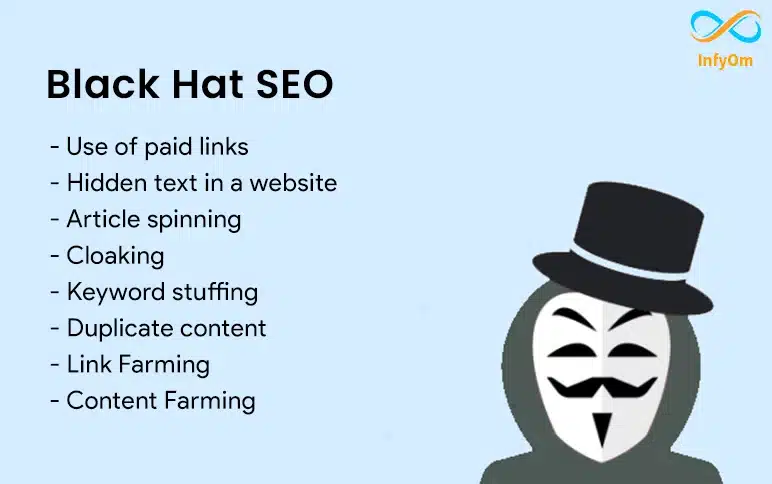
Here are the concrete tactics that fall squarely into Black Hat SEO territory:
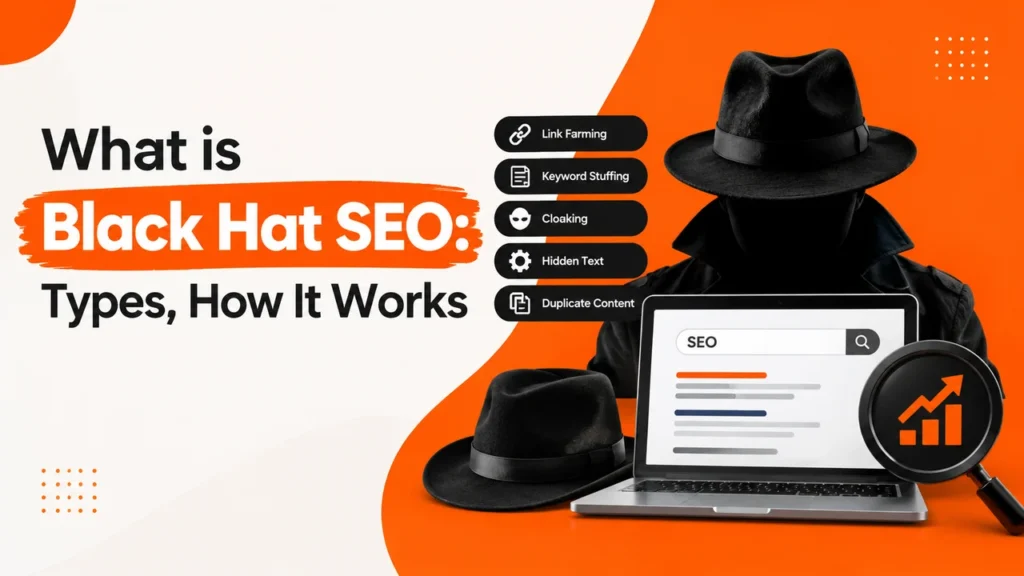
- Keyword stuffing — jamming keywords into content, meta tags, or alt text to unnaturally inflate relevance.
- Cloaking — showing one version of a page to users and another to search engines
- Sneaky redirects & doorway pages — redirecting users to different content than the indexable page or creating thin doorway pages for many search queries.
- Buying or selling backlinks/link farms — paying for links or using private networks to inflate link equity. This includes black hat link building and private blog networks.
- Auto-generated or spun content — low-quality content created at scale with little or no editorial oversight.
- Hidden text & hidden links — text made invisible to users (same colour as background, tiny font, off-screen) to fool crawlers.
You’ll also see tools and software marketed to automate these actions, black hat seo tools and black hat seo software, but they increase risk and seldom deliver sustainable results.
How Do Search Engines Detect Black Hat SEO?
How are shady tactics uncovered by Google and others?
Detection is a mix of signals and manual review. Modern search engines use pattern recognition, machine learning models, and user-behaviour metrics (bounce rate, dwell time, click patterns) to spot anomalies.
Link graph analysis finds unnatural link spikes or clustered link sources that suggest paid or private networks. When automated signals raise flags, human reviewers may check the site, and if violations are confirmed, penalties follow. Imperva’s analysis of illegal SEO tactics illustrates how link patterns and content fingerprints are key detection points.
Algorithm Updates in 2027 and Their Role in Crushing Black Hat SEO
Search engines in 2027 are far more aggressive and precise in identifying black hat SEO than ever before. Core updates now integrate AI-driven quality classifiers that evaluate intent, content authenticity, and link legitimacy at scale. This makes traditional black hat SEO methods increasingly ineffective.
Recent algorithm shifts focus less on isolated signals and more on pattern consistency. For example, black hat link building no longer fails because of one paid link, but because of repeated unnatural behaviour across domains, anchors, and timelines. Even delayed tactics are now flagged through historical data analysis.
Another major change is semantic intent validation. Search engines compare page content against real user expectations. If a page ranks for a query but fails to satisfy intent, it gets demoted, regardless of backlinks. This single change has wiped out entire networks relying on black hat SEO techniques like spun content and doorway pages.
Manual reviews have also increased for industries prone to abuse, such as finance, health, and ecommerce. Combined with AI detection, this hybrid approach leaves almost no room for sustained manipulation. In short, the faster algorithms evolve, the shorter the lifespan of black hat SEO methods becomes.
How Quickly Do Penalties Show Up, And What Do They Look Like?
How soon will you see drops in traffic, and can you recover?
Penalties vary. Some are immediate; an obvious spammy redirect or hacked page can trigger swift action. Other times, you’ll see gradual declines as algorithmic updates demote problematic sites.
Recovery is possible but often painful: you must fix the issues (remove spam links, clean up content, correct cloaking), submit a reconsideration request (if manually penalised), and then patiently wait for re-evaluation. Remember: recovery takes months, and sometimes permanent damage to the domain trust is done.
Is Black Hat SEO Ever “Good” Business?
Can the short-term traffic ever justify the long-term risk?
Short answer: No for sustainable businesses. Yes, some actors use black hat methods for quick arbitrage, get traffic, monetise, then move on before penalties arrive. But that’s not a scalable or brand-safe strategy.
For any business looking to build real equity, customer lists, brand trust, and repeat traffic, white-hat practices are the only reliable path. Digital Marketing Institute emphasises ethical optimisation and user experience as the way forward in the AI age.
Why Startups and New Domains Suffer the Most from Black Hat SEO
New websites are especially vulnerable when using black hat SEO. Unlike established domains, startups lack historical trust, brand searches, and authority signals. When black hat SEO techniques are applied early, search engines detect manipulation much faster and assign harsher penalties.
A new domain using black hat link building often shows unnatural growth patterns: sudden backlink spikes, repetitive anchor texts, and low-quality referring sites. These signals stand out more clearly without years of organic link history to balance them.
The damage is often permanent. Once a new site is flagged, regaining trust can take years, even after cleanup. In some cases, the domain never fully recovers, forcing businesses to start over entirely.
For startups trying to build traction, black hat SEO methods are not a shortcut; they’re a trap. Sustainable growth requires patience, relevance, and consistency. Early-stage brands benefit far more from clean foundations than risky experimentation.
What Are The Ethical Alternatives To Black Hat SEO?
What should you do instead to grow search traffic legitimately?
Adopt white-hat SEO: focus on intent, quality content, technical cleanliness, and natural link earning. Practical steps include:
- Deep keyword research matched to user intent.
- High-quality content that solves problems (long-form where appropriate).
- Clean site architecture and fast load times.
- Natural backlink acquisition via outreach, partnerships, and PR.
- Ongoing measurement: CTR, dwell time, conversions, not just rankings.
What About “Grey Hat” Practices — Are They Safe?

How do you tell if a tactic is borderline acceptable or outright banned?
“Grey hat” tactics live between ethical and spammy: aggressive guest posting at scale, reciprocal link schemes, or borderline content automation. Grey hat can work temporarily, but it exposes you to future penalties as detection improves. If a tactic puts you in the position of defending intent to a search engine reviewer, it’s safer to avoid it. Stick to practices where the primary beneficiary is the user, not the algorithm.
The Legal and Compliance Risks of Black Hat SEO in Regulated Industries
Beyond rankings, black hat SEO can create serious legal and compliance issues, especially in regulated sectors. Industries like healthcare, finance, education, and insurance face strict advertising and disclosure rules. Using deceptive black hat SEO techniques can result in fines, legal action, or platform bans.
Misleading content, cloaked pages, or false claims used to manipulate search visibility can violate consumer protection laws. In 2027, regulatory bodies increasingly monitor digital marketing practices, not just ads.
Search penalties are recoverable; legal penalties are not. Businesses operating in sensitive niches cannot afford the risk associated with black hat SEO methods. Ethical optimisation is no longer optional, it’s a compliance requirement.
What Role Do Tools And Software Play In Black Hat SEO?
Are there “black hat seo tools” you should watch out for?
Yes, tools that automate link buying, mass content spinning, or cloaking are marketed heavily. They promise scale but remove human judgment and quality control. Black hat seo software often leaves clear fingerprints (identical content patterns, unnatural link velocity) that make detection easier.
Use tools to assist honest SEO (audit crawlers, analytics, outreach platforms), not to replace judgment with automation for spammy tactics.
How Does Black Hat Link Building Work And Why Is It Risky?
What is black hat link building, and why does it blow up later?
Black hat link building is buying links, exchanging links in massive webs, or using PBNs (private blog networks) to generate bulk backlinks. Initially, you may see ranking lifts because backlinks remain a core ranking signal.
But link profiles created this way are often unnatural: same anchor texts, sudden spikes in referral domains, and low-quality host sites. Search engines detect these signals and devalue or penalise the site. When the links are removed or devalued, rankings tumble. It’s not worth the volatility.
How Long-Term SEO Costs Increase After Black Hat Penalties
One hidden cost of black hat SEO is how expensive recovery becomes. Cleanup involves audits, content rewrites, link removals, disavow files, and months of lost revenue. What seemed like a shortcut often becomes a financial drain.
Brands penalised for black hat SEO techniques also face higher future marketing costs. Paid ads become the only traffic source while organic visibility recovers. This dependency hurts profitability and growth planning. Ethical SEO may take longer, but it costs less over time. Black hat SEO methods create debt, technical, reputational, and financial.
How Negative SEO Uses Black Hat Techniques Against Competitors
Not all black hat SEO attacks are self-inflicted. Some competitors weaponise black hat SEO techniques through negative SEO, attempting to sabotage rival rankings. This often involves pointing spammy backlinks, hacked content, or fake reviews at a competitor’s site.
In 2027, Google is better at ignoring these attacks, but smaller sites can still suffer temporarily. Monitoring backlink profiles and setting up alerts is essential. While negative SEO is unethical, awareness helps businesses respond quickly.
Understanding black hat SEO methods also means knowing how they can be used maliciously, not just proactively.
How Can You Audit If A Site Is Using Black Hat SEO?
What checks will reveal shady optimisation?
A quick audit checklist:
- Look for hidden text/links (inspect source, check CSS)
- Scan for keyword stuffing, unnatural repetition across pages
- Run a backlink analysis for unusual spikes or clusters (many links from low-quality blogs)
- Check for duplicate content or many thin doorway pages
- Use site analytics to spot weird behaviour: instant bounces with low dwell times might indicate low-quality pages or cloaking
If you find issues, prioritise fixes by risk: remove or disavow spammy links, rewrite or remove auto-generated content, and fix cloaking/redirect problems.
How Should Companies Respond If Their Site Has Been Penalised?
What steps do you take after a penalty strike?
- Diagnose: Identify whether it’s algorithmic (sudden traffic drop after update) or manual (message in Google Search Console).
- Audit & Fix: Remove spammy links, improve content quality, remove hidden elements, and secure hacked pages.
- Document: Keep a record of actions taken, like URLs removed, emails to webmasters, and content rewritten.
- Reconsideration: If there was a manual action, submit a clear, honest reconsideration request explaining fixes.
- Monitor: Watch traffic, rankings, and manual action status; recovery can take weeks or months.
What Are Some Case Examples Or Patterns Seen In Black Hat SEO Studies?
What common fingerprints do analysts find in illegal SEO activity?
Reports and infographics analysing black-hat campaigns show recurring patterns: centralised link farms with recycled anchor text, automated low-quality content clusters, and cloaked landing pages that differ drastically in headline/CTA from the indexed version.
These fingerprints make it easier for defenders and platforms to identify malicious campaigns. Imperva’s detailed analysis highlights these recurring structures and how they map to detection heuristics.
How Will AI Change The Black Hat Vs White Hat Balance?
Will AI make black-hat tactics more dangerous or easier to detect?
AI is a double-edged sword. On the one hand, generative models can produce large volumes of readable content, which black-hat actors may abuse to scale spam. On the other hand, search engines also use AI to detect patterns, semantic coherence, and signals of automation.
The net result: opportunistic spammers might scale faster, but detection systems will also have better tools to spot abuse. The safe play is to use AI for efficiency (drafts, outlines) and strong editorial oversight, not mass production of low-value pages.
Why Sustainable SEO Wins in an AI-Driven Search Future
As AI reshapes search, black hat SEO becomes increasingly obsolete. Search engines now evaluate topical authority, authorship signals, and content depth. These are areas where black hat SEO techniques fail completely.
AI rewards consistency, originality, and usefulness, qualities that cannot be faked at scale. Brands investing in real expertise and audience value will outperform those relying on manipulation.
In the long run, ethical optimisation compounds. Black hat SEO methods reset to zero with every penalty, while sustainable strategies build momentum year after year.
What Practical Checklist Should Marketers Follow To Avoid Black Hat SEO?
How can you be sure your SEO is ethical, effective, and durable?
Quick checklist for every campaign:
- Is content written for users first, not search engines?
- Are links earned naturally or via legitimate outreach?
- Do pages load fast and match user intent?
- Is there no hidden content, cloaking, or sneaky redirect behaviour?
- Are tools used to assist, not automate spam? (Avoid black hat seo software.)
- Are you tracking user engagement metrics, not just rankings?
If any answer is “no”, fix it before scaling.
Conclusion
How do you decide between fast hacks and lasting growth?
If you want a brand that lasts, converts, and grows sustainably, white-hat SEO is the only sensible route. Black hat in SEO may deliver momentary lifts, and black hat seo methods might tempt the impatient, but the long-term costs, ranking loss, brand damage, and time spent recovering are rarely worth it. Invest in excellent content, technical hygiene, and ethical link building, and you’ll build real, compounding search equity.


FAQs About Black Hat SEO

Black Hat SEO refers to unethical, manipulative tactics that violate search engine guidelines to achieve higher rankings, such as keyword stuffing, cloaking, and private link networks.
In contrast, White Hat SEO focuses on ethical optimisation methods that prioritise user experience, quality content, and long-term sustainable growth.
The four main types of SEO are On-Page SEO, Off-Page SEO, Technical SEO, and Local SEO, each addressing a different aspect of website optimization. On-page improves content and keywords, off-page builds authority, technical ensures crawlability, and local targets visibility in regional searches.
A black hat is someone who intentionally uses Black Hat SEO tactics like unethical methods like cloaking, keyword stuffing, or invisible text, to manipulate search rankings.
The term originates from hacking culture, where “black hats” engage in deceptive or rule-breaking practices for personal gain.
The purpose of a black hat is to exploit search engine algorithms for quick, short-term ranking gains using manipulative techniques.
However, this approach risks penalties, de-ranking, and long-term damage to credibility, making it an unsustainable strategy compared to ethical White Hat SEO practices.
Yes. Severe or repeated use of black hat SEO methods can lead to permanent de-indexing, especially for repeat offenders.
No. Black hat link building may cause brief fluctuations, but detection systems neutralise gains quickly.
Only if it’s mass-produced, low-value, or deceptive. AI itself isn’t black hat; misuse is.
Monitor backlinks, secure your site, and review content regularly to detect suspicious activity early.
Often yes. Domain trust loss can take years to rebuild.
Yes. Smaller sites lack authority buffers, making penalties more damaging.