What Is Grey Hat SEO – How It Works, Benefits, & Expert Tips

SEO isn’t always black and white. While Google lays down the rules, real-world marketers often find themselves walking a fine line between what’s “allowed” and what actually gets results. That’s where grey hat SEO comes in.
It blends advanced strategies that are neither fully white hat nor fully black hat. By this, the marketers achieve effective outcomes without being excessively manipulative.
Grey hat SEO is a mid-level technique that pushes boundaries, identifies the loopholes, and delivers faster wins while still flying under Google’s radar (at least for now).
Recent data predicts that more than 35% of competitive business niches are implementing some form of grey hat SEO tactics to boost ranking speed. It has growing relevance in 2027, with more businesses showing up every day. As there is increasing competition, the SEO tactics need to be effective for the desired reach and drive in potential web traffic.
If you’ve ever felt frustrated by how long “safe” SEO takes or are curious about what your competitors are doing to rank faster, understanding grey hat SEO is crucial. Chances are, they’re already using it.
How Does Grey Hat SEO Work in Practice?
Here’s the tricky part: when grey hat SEO works by finding loopholes in Google’s algorithm. Google publishes guidelines, but those guidelines can be vague. Marketers then look for creative ways to push the boundaries without outright breaking the rules.
For instance, a case study from 2024 showed how a tech blog gained better reach and traffic of almost 40% reach in 3 months, by mindful use of expired domains and appropriate links in the blog.
For example, some marketers use expired domains with backlinks to funnel authority to their site. Is that explicitly banned? Not always. Is it risky? Definitely.
The goal is to strike a balance: push far enough to see ranking improvements, but not so far that your site gets penalized. If you move too fast, Google may penalize the website, so that strategic movement can reward and pay off, with long-term benefits.
Many agencies secretly lean on grey hat SEO tactics because they deliver results faster than white hat methods, without the immediate danger of black hat tricks.
Common Grey Hat SEO Tactics
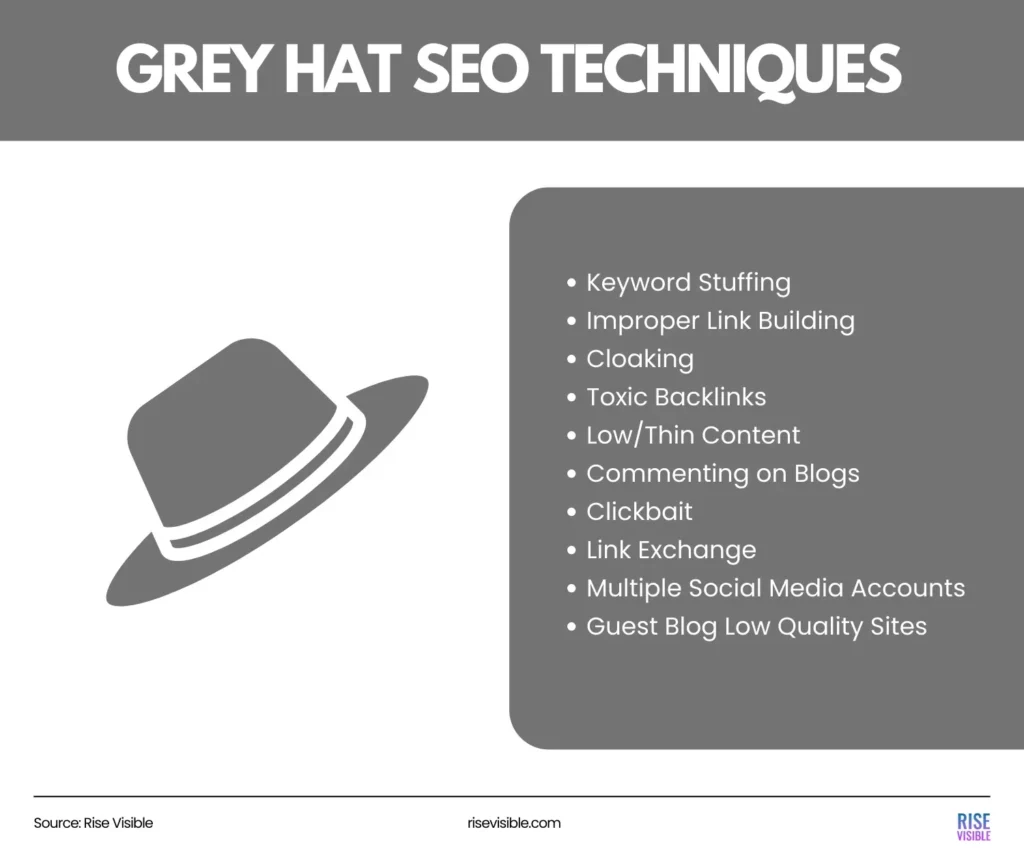
When trying to find the answer to what is grey hat SEO all about, going through some common tactics helps grasp a better idea of how the optimization strategy works. The commonly used tactics are listed below:
1. Expired Domains Having Backlinks
One of the oldest plays in the grey hat book is buying an expired domain that already has authority and backlinks.
Marketers now check domain history and the quality of backlinks using SEMrush or Ahrefs before redirecting the links or preventing the chance of penalties.
Marketers then redirect it to their main site or repurpose it with fresh content. If the backlinks are spammy or irrelevant, Google will catch on fast.
2. Private Blog Networks (PBNs)
PBNs are a network of websites set up for the sole purpose of linking back to your main site. When each site looks real with unique content, hosting diversity, and a bit of organic activity, PBNs can be powerful.
Use unique content generators and different hosting locations to ensure PBNs as natural ones. However, try to stay away from over-reliance.
But Google has advanced in identifying the irrelevant sites and content. If a PBN powers your entire backlink profile, it’s only a matter of time before you’re flagged from Google search results.
3. Buying Links Under the Radar

We all know buying links is against Google’s rules. But let’s be real, people still do it. The difference with grey hat SEO is that the links are placed strategically: in relevant articles, on high-quality sites, and in ways that look natural. This makes it harder for Google to spot.
Still, if your competitors report you or Google sniffs out a pattern, you could face penalties. SEO strategies suggest that buying links isn’t bad if it is done thoughtfully. It should aim for replacement, relevance and effective content moderation to show up in the search results in 2027.
4. Cloaking Content
This tactic involves showing one version of a page to search engines and a different one to users.
Only consider micro-level content variations, as full-scale cloaking may lead to deindexing issues.
For example, you might load keyword-heavy content for Google while serving a sleek, minimal page to visitors. Cloaking can trick search engines into ranking you higher, but it’s risky. If caught, it can get your site deindexed overnight.
5. Aggressive Guest Posting
Guest posting is legit when done for authority and reach. But when the primary goal is backlinks, it starts drifting into grey territory.
Think guest posts with thin content, keyword-rich anchor text, and little value for the reader. Google’s algorithms are getting sharper at detecting these patterns, so balance is key.
As an action step, you can prioritize the sites with engaged audiences over focusing on link quantity to stay within safer optimization boundaries.
6. Clickbait-Style Content Spinning
This one sit right on the fence. It’s when you take existing content and “spin” it just enough to make it look new, usually with clicky titles and slightly tweaked paragraphs.
Did You Know that in 2027, AI tools can spin content to a great extent to ensure uniqueness, but often fail to attain the readability and credibility of content. This is when content spinning should be done mindfully, and every aspect of the content quality and relevance should be checked before it is posted online.
The content isn’t unreadable (like in black hat spinning), but it’s often shallow. Overusing this tactic can water down your brand credibility, even if it temporarily boosts your rankings.
So, are these tactics all bad? Not exactly. Many marketers use them without immediate consequences. But the problem with leaning too hard on grey hat SEO is that Google constantly updates its algorithm.
What slips through today could land you in trouble tomorrow. The safest strategy is moderation: blend these methods with white hat practices so you’re never putting all your eggs in the risky basket.
Things to Know About Grey Hat SEO
Google updates its algorithm 500 to 600 times yearly. What works today with grey hat SEO can turn out to be risky tomorrow. So, it needs mindfully crafted strategies to properly optimize content and a website, ensuring complete relevance.
Some of the top Fortune 500 companies leverage grey hat SEO tactics, giving a competitive edge to others, without public disclosure.
Article spinning was once considered black hat, but it is now a gray SEO strategy, if done properly. The spinning should be unique and relevant, as per the content requirement in 2027.
Is Grey Hat SEO Really Risky?
Yes and no. It’s all about how far you push.
The AI-driven updates in 2027 can even make some safe grey hat strategies risky to use, especially when using automated link-building and content generated using AI tools.
On one hand, grey hat SEO can deliver serious gains. If your competitor is playing it safe and you’re bending the rules strategically, you’ll often outrank them.
On the other hand, Google isn’t blind. Every year, algorithm updates crack down on manipulative practices.
The risk is that what’s “grey” today can become “black” tomorrow. For example, in the past, mass directory submissions were considered normal. Today, they’re a red flag.
So, is it risky? Absolutely. But the risk varies.
Considering some latest industry insights, it can be said that Grey hat SEO should not be used solely. It should be integrated with other SEO methods to lower the risks and ensure a fast and effective outcome.
One should not consider gray SEO as a shortcut, as it is a strategy. If marketers know how to use it right and in the right place, it can prevent penalties in digital marketing. Short-term campaigns may benefit, but long-term brands should focus on moderation and effectively integrate the white hat strategies. So, before you plan to implement strategies in content, ensure that you can get long-term returns and boost its reach.
Updated Trends to Watch in Grey Hat SEO
- AI-Driven Grey Hat Tactics – Use the smart automation tools to handle tasks like link placement, recreate content, or adjust keywords in a way that sounds natural and keeps patterns unpredictable.
- Niche-Specific PBN Use – It is better to target small niches with low competition, as it also reduces the risk of a penalty.
- Hybrid Link Building – Combine the organic links with a limited set of high-end purchased links to experience the best results.
This is how you can make the most of the grey hat SEO and optimize website content for effective reach.
Steps to Follow for Safe Implementation
- Audit your current SEO to see where white hat and gray strategies can mix
- Select some low-risk gray hat tactics, such as guest posting or using high-quality expired domains on your website content
- Diversify backlinks if you don’t want to rely only on one strategic tactic
- Monitor the results in frequent intervals to understand the adjust the performance level and stay aligned with the Google updates
- Document the changes so you have a comprehensive plan if a tactic leads to a penalty
What Are the Benefits of Grey Hat SEO?
Let’s talk about why people use it.
- Speed – You’ll often see faster results than what white hat SEO promises.
- Cost-effectiveness – Buying a few high-quality grey hat links is cheaper than planning organic campaigns.
- Competitive edge – Aggressive players make effective use of grey hat SEO to stay visible in the competitive market, depending on the niche industry.
- Control – You should plan strategies to actively manage traffic with adequate website authority. You have to make things happen, just the ways in which you want organic growth for your business.
That’s how the big brands rely on grey hat SEO to show the magic. Th
ey know Google won’t catch everything, and the upside is often worth the calculated risk.
What are the Common Mistakes to Avoid?
- Don’t over-rely on PBNs without diversification.
- Spinning content to such an extent that it impacts brand authority and credibility.
- Ignoring the algorithm updates resulting in penalties.
- Use of spammy domains.
- Focus on speed instead of long-term results.
So, you have to be particular about the above points and try to fix them, to reduce the chance of the mistakes or errors impacting the web traffic or its online viability.


FAQs on Grey Hat SEO

In most cases, grey hat methods show faster results than white hat techniques. Results may also show within 3 to 6 weeks, and it depends on backlinks, content quality, and the competition in the niche industry.
Even if you use the same technique for a long time, do it with moderation. Avoid tactics that depend on unnatural links. Instead, rely on one that focuses on controlled and relevant approaches along with the white hat efforts.
Automated link generation or AI-powered outreach becomes grey hat when the links aren’t fully earned or editorially placed. Google reacts quickly to unnatural patterns.
Refresh expired content and try to repurpose old pages. This can be a simple yet low-risk method to drive in website traffic. It further strengthens topical website authority without having to include risky backlinks.