What Is Generative AI: How It Works, Types, Complete Guide


Everywhere you look, people are talking about generative AI. And for good reason, it can write blog posts, design visuals, or even generate code in seconds.
The generative AI definition is simple: it’s a branch of artificial intelligence built to create content with text, images, audio, video, and more, based on patterns learned from massive datasets.
And here’s the kicker: this isn’t a “someday” technology. From e-commerce personalization to marketing automation and healthcare breakthroughs, generative AI is already rewriting the playbook.
In this guide, we’ll unpack exactly what generative artificial intelligence is, how it works, the types you should know, and where it’s headed next.
Key Highlights
- Generative AI defined: AI systems that create original content, text, images, music, video, and code, based on patterns in massive datasets.
- How it works: Models are trained on huge data libraries, recognize patterns, and generate new outputs through architectures like transformers, GANs, diffusion models, and VAEs.
- Main types: Text, image, audio/music, video, and code generation, each transforming industries from marketing to software development.
- Current uses: Powering e-commerce personalization, marketing campaigns, healthcare research, entertainment, and developer productivity.
- Benefits: Faster workflows, creativity at scale, personalized experiences, and cost savings across industries.
- Risks: Biased outputs, factual inaccuracies, copyright disputes, deepfake misuse, and high environmental costs.
- Getting started: Begin with clear goals, clean data, the right tools, and prompt engineering for better results.
- Future outlook: Multimodal AI, on-device deployments, AI copilots across workflows, and growing regulation on ethics and transparency.
What is Generative Artificial Intelligence in Plain English?
When people hear about the generative AI meaning, they often think it’s overly technical. But the concept is surprisingly simple. Imagine typing a sentence into your laptop and receiving a polished blog post in seconds. Or humming a tune and watching a program, turn it into a full piece of music. That’s the idea.
People sometimes ask, “So, really, what is generative artificial intelligence?” The truth is, it’s just another way of describing the same thing: AI that can create, not just calculate.
In industry, you’ll often hear the shorter label gen AI, and in casual talk, people even phrase it as “what is gen AI.” Whatever version you use, it all points back to one principle: machines that generate original work instead of simply processing data.
And here’s where it ties back to the broader AI definition: artificial intelligence is a system capable of perceiving, learning, and taking action. Generative systems simply take this further by making new, original content.
How Does Generative AI Work?
Understanding the mechanics behind generative AI makes it less mysterious.
Training on Massive Datasets
Coursera highlights that these models feed on data: books, websites, images, audio recordings, and even code repositories. The system looks for patterns, rhythms, and structures in that data, essentially building a giant mental map of how humans communicate, design, or create.
Predicting and Producing Outputs
Once trained, the model responds to prompts by predicting what comes next. Word by word, pixel by pixel, it generates an output that aligns with the patterns it has learned. Bloomreach points out that this is why prompts are so important; the right prompt can mean the difference between a mediocre answer and a masterpiece.
The Architectures That Power It:
- Transformers: Ideal for text and code, these models power tools like ChatGPT.
- GANs (Generative Adversarial Networks): Perfect for images, as one model generates while another critiques.
- Diffusion models: IBM Research highlights these as top performers for lifelike images and videos.
- VAEs (Variational Autoencoders): Often used in more structured creative outputs, such as 3D designs.
What Are the Main Types of Generative AI?
Generative AI isn’t a one-trick pony. It comes in different forms, each designed to create a specific type of content. Whether it’s words on a page, visuals on a screen, or lines of code, the applications are everywhere. Let’s walk through the big ones.
Text Generation
This is where most people first encounter generative AI. From drafting blogs and emails to building chatbots that sound human, text generation is everywhere. It gives writers a running start, helps customer service teams scale responses, and even powers translation tools that adapt to tone and context.
Image Generation
Visual creativity is being transformed. Tools like MidJourney and Stable Diffusion turn simple prompts into professional-grade images. Designers can brainstorm logo ideas, marketers can create ad visuals, and artists can push their imagination further, all without starting from scratch.
Audio and Music
Generative AI doesn’t stop with words or images. It can compose music tracks in different styles, replicate voices with uncanny accuracy, and even produce custom sound effects. Musicians and podcasters are already experimenting with these tools to expand their creative toolkit.
Video
Video is resource-heavy, but generative tools are breaking down barriers. Some platforms can generate short clips from text instructions, while others enhance existing footage with smoother visuals or added elements. For brands and creators, that means producing engaging video content without Hollywood budgets.
Code
For developers, generative AI is like having an extra teammate. Tools such as GitHub Copilot generate code snippets, automate repetitive testing, and reduce debugging time. Instead of spending hours on boilerplate code, engineers can focus on solving core problems and building smarter applications.
As Appventurez notes, models can be trained for general creativity or fine-tuned for specific industries. Salesforce adds that we’ll see both massive foundation models and smaller, domain-focused versions shaping the market.
Where Is Generative AI Being Used Right Now?
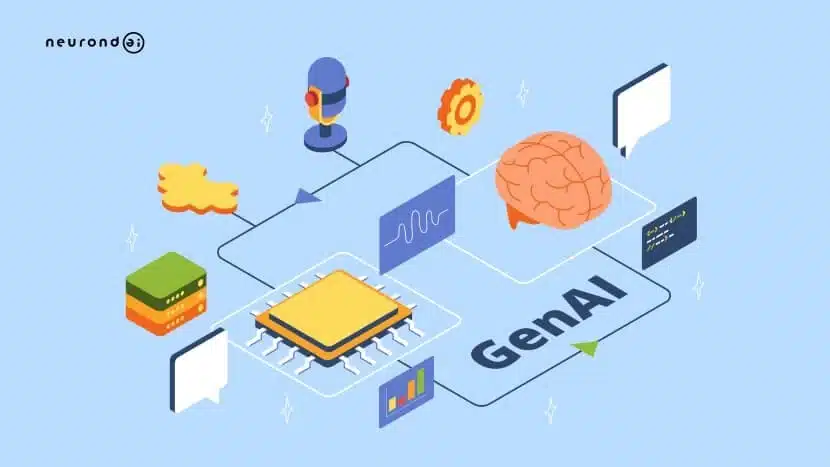
This is where the technology moves from hype to reality. Generative AI isn’t stuck in research labs anymore; it’s in ecommerce stores, marketing teams, hospitals, studios, and even developer workflows. Let’s break it down.
E-commerce and Retail
Shoppers want personalized experiences. Bloomreach shows how retailers are already using generative AI to write tailored product descriptions, design visuals that match customer preferences, and recommend products in real time. The result? More engaging shopping journeys and higher conversions without adding more staff.
Marketing and Sales
Salesforce makes it clear: marketing teams are getting campaigns out the door faster than ever. Think personalized emails, targeted ad copy, and social content, all created in minutes. Instead of weeks of back-and-forth revisions, brands can test ideas instantly and double down on what works.
Healthcare and Research
IBM Research highlights one of the most impactful use cases: drug discovery. Generative models can design molecules, simulate interactions, and speed up lab testing. What used to take years now takes months, and that acceleration could literally save lives.
Entertainment and Media
Artists, musicians, and filmmakers are embracing generative AI as a creative partner. Need concept art? Want a new beat? Looking to enhance visual effects? The tools are already here, helping creators experiment and push boundaries without the same budget or time constraints.
Software Development
Developers aren’t left out. GeeksforGeeks points to GitHub Copilot and similar tools that make writing code faster and easier. Instead of starting from scratch, engineers can generate snippets, automate repetitive work, and focus on solving bigger problems.
What Benefits Can Generative AI Deliver?
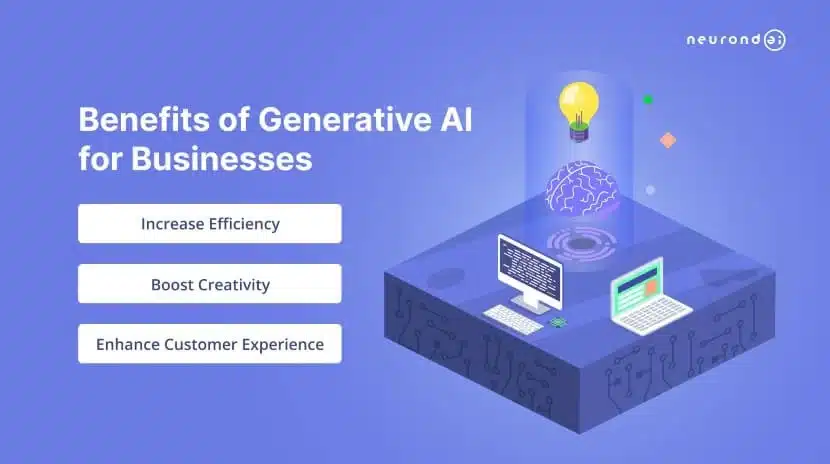
Let’s be real. The buzz around generative AI isn’t just smoke and mirrors. It’s driving results that are hard to ignore. Companies are saving time, cutting costs, and connecting with customers in ways that weren’t possible even a few years ago. Here’s where the real wins are happening:
Efficiency and Speed
Think about how much time your team wastes on repetitive work. Drafting emails, resizing images, or writing endless variations of ad copy. With generative AI, what used to take days can now be done in minutes. That means your people spend less time grinding and more time executing big ideas.
Creativity at Scale
Ever sat in front of a blank screen waiting for inspiration? We all have. Generative AI kills that roadblock. It gives you a starting point, whether it’s ten versions of a blog intro or three logo designs you can refine. You don’t lose creativity; you multiply it. Suddenly, brainstorming isn’t limited by time or energy.
Personalization
Your customers don’t want generic. They want content that feels like it was made for them. Bloomreach points out that personalization is no longer a nice-to-have; it’s expected. Generative AI makes that scalable. You can tailor product descriptions, recommendations, or campaigns for each customer without breaking your workflow or your budget.
Cost Savings
Here’s the kicker: all of this also saves money. Automating repetitive tasks cuts down on overhead. Instead of hiring more people to do more grunt work, you can reallocate those resources into growth and innovation. The ROI speaks for itself: faster production, lower costs, and more bandwidth to test new ideas.
What Risks Should You Watch Out For?
Like any groundbreaking technology, generative AI isn’t without its challenges. While its potential is massive, some areas demand caution and careful management. Here are some of the key risks businesses and creators need to keep in mind:
- Generative systems can produce content that looks polished but is factually wrong, which makes human review and oversight crucial
- Outputs may unintentionally reflect biases present in the training data, reinforcing stereotypes or unfair assumptions
- Ownership of AI-generated works is still legally unclear, raising the risk of disputes around copyright and intellectual property
- Tools capable of creating engaging media can also be misused to spread false information, deepfakes, or harmful narratives
- Training and running large-scale models consume significant energy, adding pressure to environmental sustainability efforts
Ethical Use of Generative AI
The next frontier for generative AI optimization is responsibility. With power comes accountability.
Companies must establish ethical guidelines, ensuring AI outputs are transparent, bias-free, and respect intellectual property. IBM’s ongoing research emphasizes fairness, explainability, and environmental sustainability as central to all AI development.
Organizations adopting gen AI in 2025 must invest in audits and governance to ensure they’re using AI responsibly, not recklessly.
The Role of Data Quality in Generative AI Performance
Clean, diverse data is the foundation of every generative AI model. Poor-quality datasets lead to inaccurate or biased outputs.
For reliable results, businesses need:
- Curated, high-quality data sources
- Regular data audits to remove bias or duplication
- Compliance with privacy and copyright laws
Data is the fuel of gen AI, the better the fuel, the better the machine performs.
Comparing Generative AI with Traditional AI
Traditional AI is about analysis, it classifies, predicts, and optimizes. Generative AI, however, is about creation, it designs, composes, and invents.
While older models focused on decision-making (like spam filters or recommendation engines), generative AI adds imagination to computation. It’s not just interpreting data; it’s producing new possibilities from it.
This distinction is what makes generative artificial intelligence the most transformative leap since the invention of machine learning.
Generative AI in Education and Learning
The classroom of 2026 looks nothing like before. Generative AI is creating personalized learning paths, generating quizzes, and offering tutoring through conversational bots.
Teachers are using gen AI to simplify lesson planning, while students use it to grasp complex topics faster. When used responsibly, AI becomes a learning companion not a shortcut.
The Future Workforce and Gen AI Collaboration
Instead of replacing jobs, gen AI is reshaping them. Routine work is being automated, while creativity, strategy, and emotional intelligence are becoming more valuable.
In 2025 and beyond, professionals will use generative AI as a partner, an assistant that amplifies human ideas and execution. Teams that learn to work with AI, not against it, will lead the next wave of innovation.
Environmental Impact and Sustainable AI Development
Training large AI models consumes enormous energy. Future generative AI optimization will focus on sustainability, using efficient model architectures, recycling data, and deploying on low-power chips.
As IBM Research notes, “green AI” is no longer optional. It’s essential for balancing innovation with global responsibility.
Retailers are boosting conversions with AI-personalized shopping. Marketing teams are cutting campaign times from weeks to days. Healthcare labs are discovering drugs faster than ever. Software developers are coding with fewer errors and higher speed.These examples show that generative AI is not just theoretical, it’s practical, profitable, and transformative.
How Can Businesses Start Using Generative AI?
Coursera suggests starting with clear goals: do you want faster content, improved customer support, or personalization? Once that’s clear, choose the right tools. From open platforms like Hugging Face to enterprise solutions like Salesforce’s Einstein GPT, there are options for every budget.
Appventurez reminds us that success also depends on infrastructure and clean data. Start small, pilot your projects, and scale only when you see results. And as Bloomreach stresses, learn prompt engineering. Asking the right question often determines whether the output is useful.
What’s Next for Generative AI?
IBM Research predicts a future where multimodal systems handling text, image, video, and audio simultaneously become the norm. Edge deployment will allow these models to run directly on devices, making them faster and more private.
We’ll also see AI co-pilots embedded in every workflow, from marketing to medicine. And regulation will catch up, bringing rules around copyright, transparency, and safety. Most importantly, the future is about collaboration. Generative AI won’t replace people; it will empower them.
Success Stories and Case Study
Retailers are boosting conversions with AI-personalized shopping. Marketing teams are cutting campaign times from weeks to days. Healthcare labs are discovering drugs faster than ever. Software developers are coding with fewer errors and at a faster speed.
All these examples prove one thing: generative AI isn’t theory anymore, it’s ROI. The businesses jumping in early aren’t just experimenting; they’re carving out a competitive edge that late adopters will struggle to catch up to.
How Klarna Cut Marketing Costs Using Generative AI
In 2024, fintech company Klarna became one of the most notable success stories demonstrating the power of generative AI in real-world business operations. By adopting AI-driven tools for marketing and customer service, Klarna reduced costs dramatically while scaling creativity and efficiency.
The Challenge
Klarna’s marketing and design teams were struggling with high creative production costs and long turnaround times for campaign visuals. Each campaign required multiple image variations across global markets, often involving external agencies, an expensive and time-consuming process.
With the surge in e-commerce competition, Klarna needed faster content creation to stay relevant and adapt to trends in real time.
The Solution
In early 2024, Klarna integrated generative artificial intelligence tools such as Midjourney, DALL·E, and Adobe Firefly into its content production workflow. The goal was to automate visual generation while maintaining brand identity and creative quality.
The company’s design team produced over 1,000 marketing images within the first three months of the initiative, all generated in-house using gen AI tools. Additionally, Klarna introduced AI-powered assistants for customer service, built in collaboration with OpenAI, which streamlined thousands of daily customer interactions.
The Results
| Metric | Before Generative AI | After Generative AI |
| Image Production Costs | High (external agency dependence) | Reduced by approximately $6 million annually |
| Total Marketing Cost Savings | Baseline | $10 million annual savings across campaigns and design workflows |
| Time to Produce Campaign Images | ~6 weeks per campaign | Reduced to 7 days using AI-generated content |
| Volume of Campaign Variations | Limited | Expanded exponentially, allowing real-time visual adaptation |
The Takeaway
This case proves that what is generative AI is not just an abstract idea, it’s a cost-efficient, productivity-enhancing tool reshaping creative industries. Klarna’s adoption shows that gen AI can handle repetitive creative workloads, allowing human designers to focus on strategic and impactful storytelling.
The results illustrate the broader generative AI meaning: systems capable of producing original, brand-consistent content at scale, with accuracy, speed, and personalization. It highlights how businesses across industries can move beyond testing to full-scale integration of generative artificial intelligence for measurable ROI.
FAQs
1. What is Generative AI?
Generative AI is a branch of artificial intelligence that can create new content, text, images, music, code, and more, based on patterns learned from data.
2. How does Generative AI differ from traditional AI?
Traditional AI analyzes data to make predictions. Generative AI, by contrast, uses that data to generate entirely new and creative outputs.
3. What are the main types of Generative AI?
Text, image, audio, video, and code generation are the core types, each transforming industries in unique ways.
4. What are the risks of using Generative AI?
Risks include biased or incorrect outputs, data privacy issues, copyright concerns, and environmental costs from model training.
5. How can businesses start using Generative AI?
Start with small projects, content creation, automation, or personalization. Use trusted on page AI services and monitor outcomes closely.
6. What industries benefit most from Generative AI?
E-commerce, healthcare, media, and software development are seeing massive value from gen AI adoption.
7. What’s the future of Generative AI?
The next phase includes multimodal AI (handling text, image, and audio), on-device models for privacy, and stronger global ethics regulations.
Final Thoughts
Generative AI is not a fancy word or a tech experiment in 2025, it’s a revolution in how we create, communicate, and work. From automating repetitive tasks to producing original content at scale, the possibilities are almost limitless.
Businesses like Klarna show that the right use of gen AI can save millions, boost efficiency, and unlock creativity previously constrained by time and resources.
The bigger question isn’t simply “what is generative AI?”; how will you leverage it to stay ahead? Whether you are a marketer, designer, developer, or entrepreneur, using generative AI tools today can change the way you approach work and that might lead you towards innovation.
The future belongs to those who experiment responsibly, learn fast, and adapt AI to real-world challenges. As regulations, ethics, and technology continue to change and grow, early adopters will lead industries with smarter, faster, and more personalized solutions.
In short: Generative AI isn’t the future, it’s the present. And the question isn’t if it will transform your business, but when.