All SEO
  SEO News
  SEO Strategy
  Ask An SEO
  Enterprise SEO
  Google Algorithm Updates
  International SEO
  Link Building
  Local SEO
  Mobile SEO
  On-Page SEO
  Technical SEO
  Vertical SEO
  Wordpress for SEO
  Web Dev for SEO
  SaaS SEO
  E-commerce SEO
  AI-Driven SEO
CMS Platforms and Plugins Are Quietly Defining Technical SEO Standards, Web Almanac Finds


New data shows the foundations of modern SEO are increasingly set by systems, not specialists
Technical SEO has long been treated as a craft discipline. Practitioners debate canonical logic, structured data frameworks, crawl control strategies, and metadata precision as though each website were a custom engineering project.
But new analysis from the 2025 Web Almanac suggests something more structural is happening: much of the web’s technical SEO baseline is being determined before an SEO professional ever touches a site.
The reason is simple. More than half of the web now runs on a content management system.
CMS Platforms Now are Behind the Majority of the Web
The 2025 Web Almanac confirms that over 50% of websites in the HTTP Archive dataset are built on CMS platforms.
Out of roughly 16 million sampled sites, the majority operate on structured publishing systems rather than fully bespoke codebases.
WordPress is dominant by a wide margin. This is despite a slight dip in recent data. It continues to hold the largest share of CMS-driven sites globally.
Behind it, Shopify has carved out substantial influence in ecommerce. Wix, Squarespace, Drupal, Joomla, Webflow, Ghost, and TYPO3 also account for smaller but significant portions of the ecosystem.
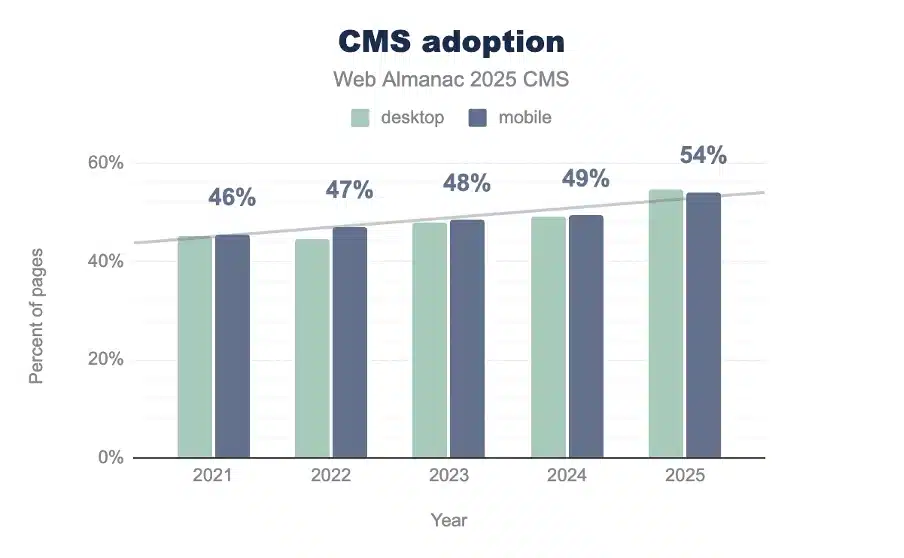
When more than half the web inherits technical configurations from these platforms, they effectively become standard-setters.
SEO Best Practices Now Ship as Default Features
Across leading CMS platforms, foundational SEO elements are now embedded into the system itself. While implementation quality may vary, most major platforms provide:
- Descriptive, search-friendly URLs
- Editable title tags and meta descriptions
- XML sitemap generation
- Automatic canonical tags
- Meta robots directives (index/noindex controls)
- Basic structured data outputs
- Some form of robots.txt access or auto-generation
Fifteen years ago, many of these required custom development. Today, they are routine.
This does not eliminate the need for SEO professionals. It does, however, raise the technical floor. A new site built on a mainstream CMS typically launches with baseline SEO functionality already active.
The debate, in many cases, shifts from “Does this exist?” to “Is it configured optimally?”
Canonical Tag Adoption Closely Mirrors CMS Growth
When canonical tag implementation data is compared against CMS adoption rates in the HTTP Archive, a strong correlation emerges.
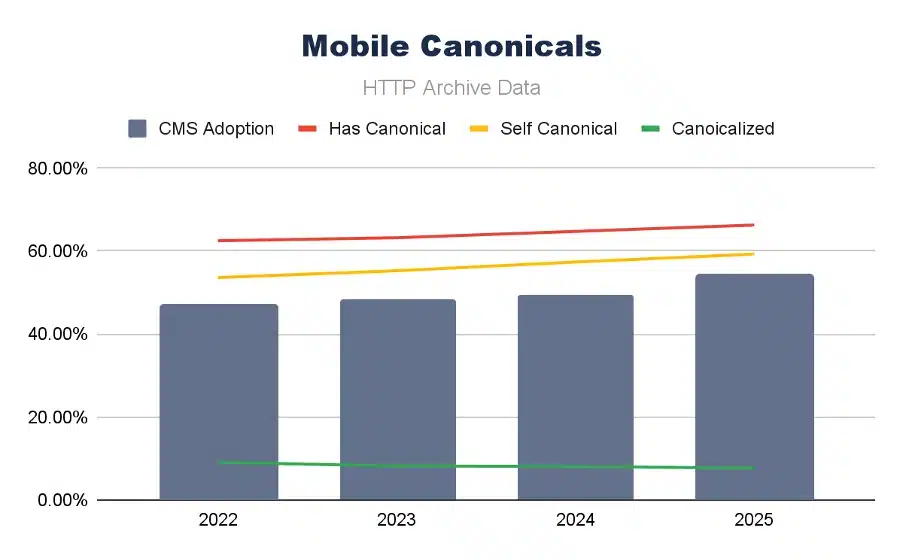
As CMS usage rises, canonical tag presence increases in near parallel. Self-referencing canonical URLs – now a default behavior across many platforms have become normalized across both desktop and mobile pages.
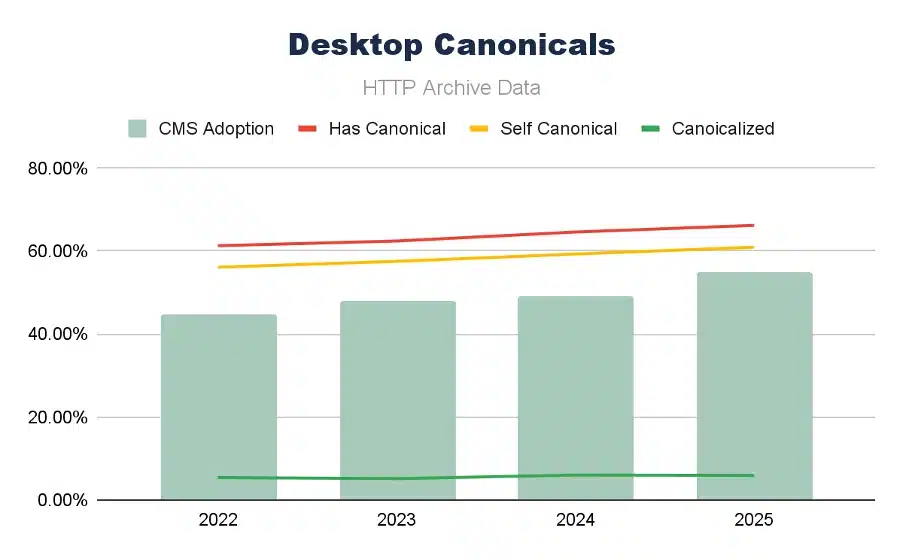
A Pearson correlation analysis confirms the strength of this relationship. Canonical tag implementation and CMS adoption track closely over the last four years.
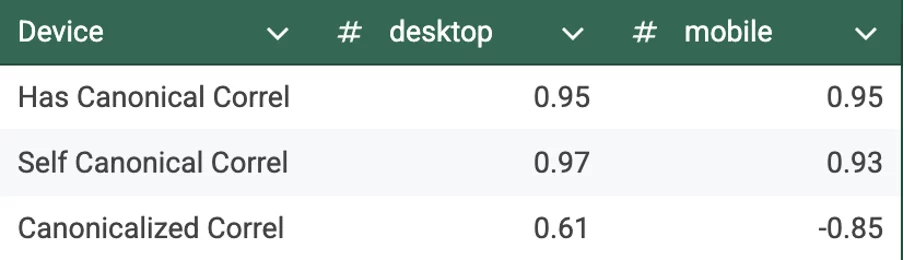
One nuance appears in mobile data, where a decline in canonicalized URLs creates a slight negative correlation in certain metrics.
The reasons are not definitive. Changes in mobile rendering, implementation shifts, or site architecture updates may contribute. However, broadly speaking, canonical behavior is increasingly system-driven.
Structured Data Adoption Is Growing, But Not Universal
Schema.org implementation also shows a relationship with CMS growth, though the signal is weaker.
Common SEO-relevant types such as Article, BlogPosting, and Product- have seen gradual increases. However, overall structured data adoption still trails far behind total CMS penetration.
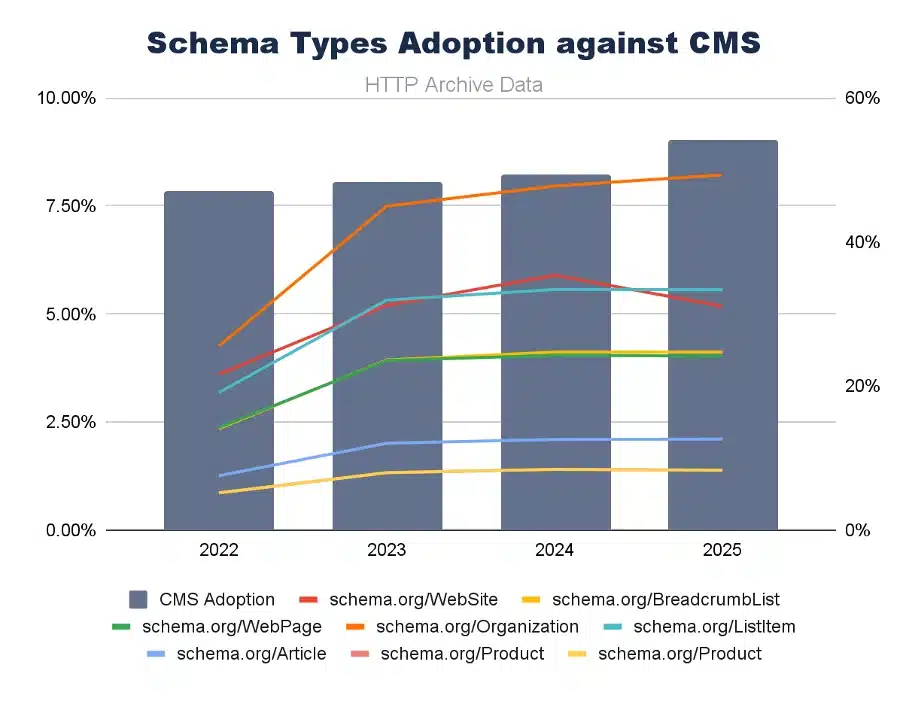
The reason is structural. Many CMS platforms provide limited, templated schema outputs. Deeper, highly customized structured data remains an intentional, specialist-driven activity.
From a search engine or AI perspective, this uneven adoption presents challenges. Structured data cannot yet be assumed as universally reliable across the web.
Robots.txt Is Becoming a Governance Layer
Robots.txt implementation offers another example of CMS influence.
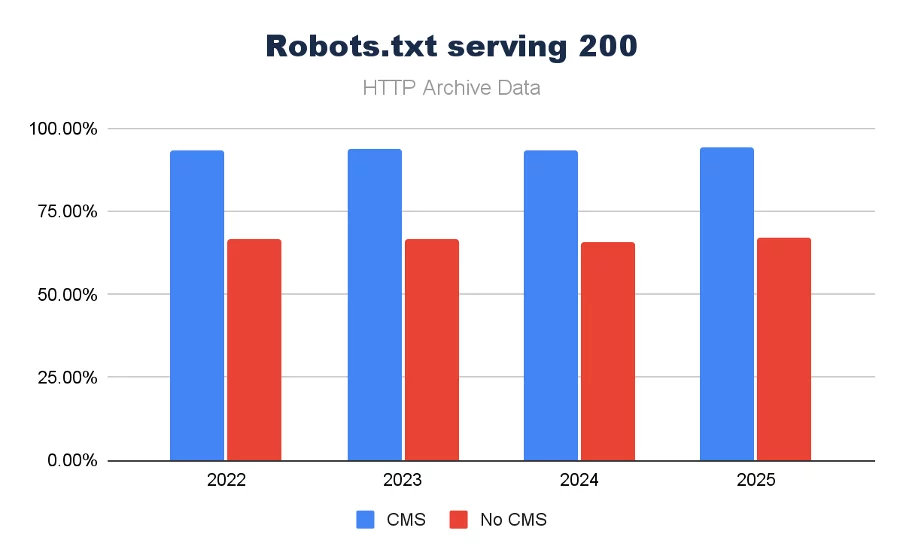
Over the past four years, CMS-driven sites have significantly increased the number of valid robots.txt files that serve 200 responses. Non-CMS sites show higher rates of invalid or misconfigured files.
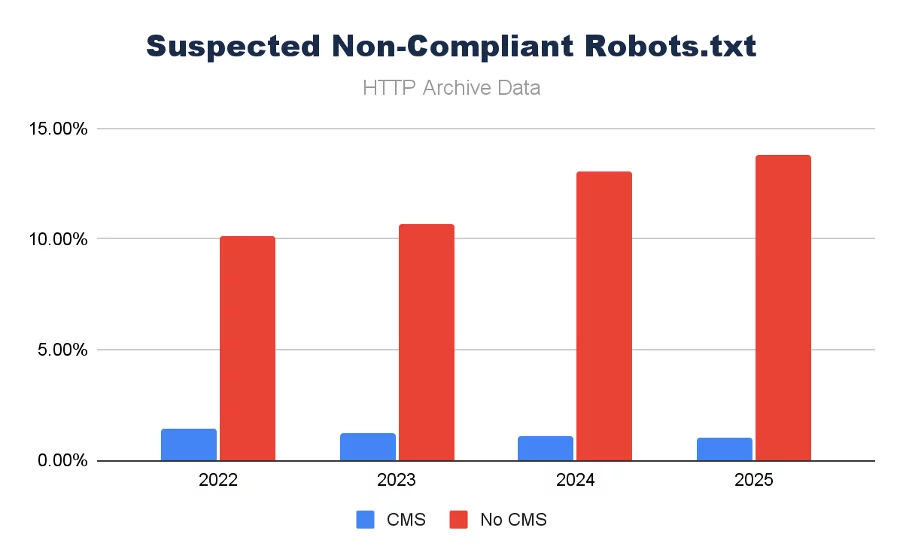
When filtering for files that contain actual user-agent declarations – a proxy for legitimate configuration – nearly 14% of robots.txt files on non-CMS platforms may not function as true robots directives.
CMS platforms reduce this margin of error by auto-generating compliant files or providing structured editing tools.
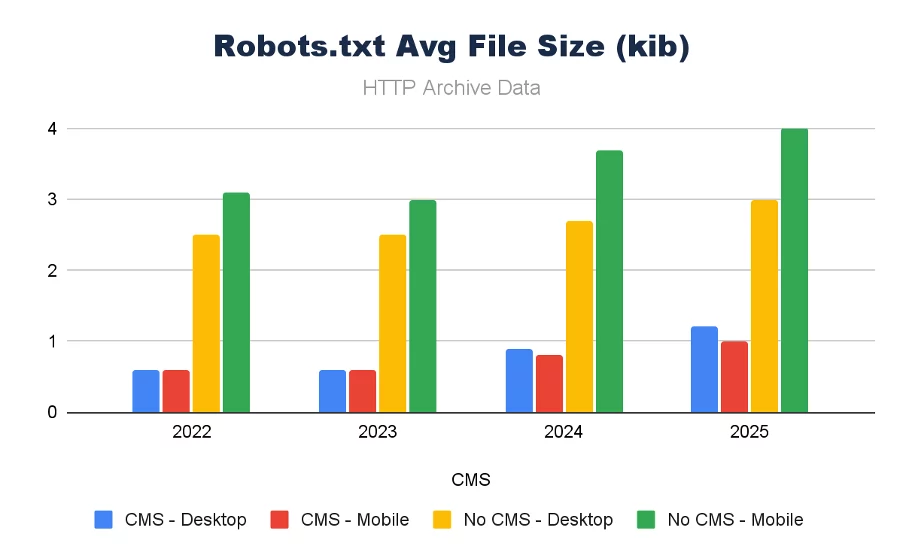
Beyond housekeeping, robots.txt is evolving. The Web Almanac notes its growing use as a governance mechanism, particularly in the context of AI search and crawler management.
This shift underscores how CMS defaults influence not just technical hygiene, but emerging search protocols.
WordPress Plugins Extend the Standard Further
Within the WordPress ecosystem, SEO plugins amplify default capabilities.
The most widely installed tools include:
- Yoast SEO
- Rank Math
- All in One SEO
Even Yoast SEO, the most common, appears on just over 15% of WordPress sites. At WordPress scale, it represents millions of websites.
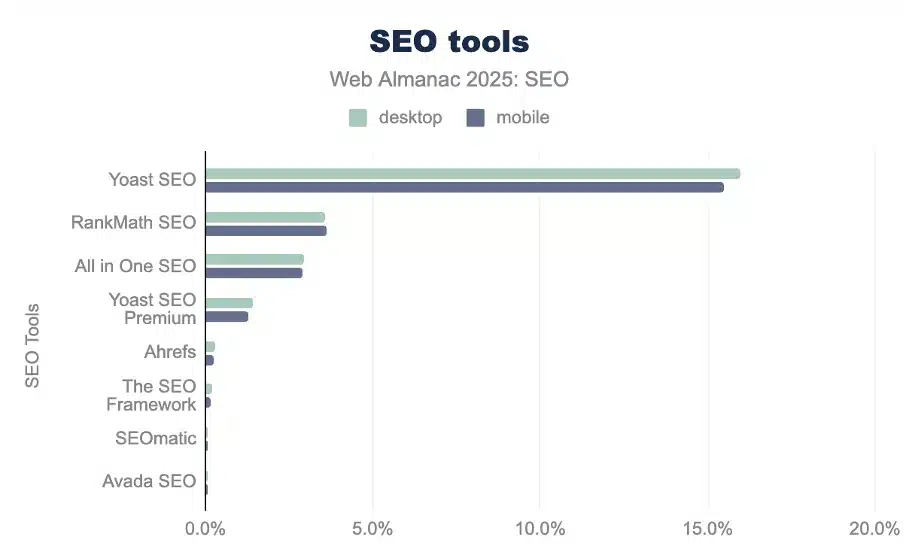
These plugins standardize
- Explicit index/follow meta robots directives
- Automatic self-referencing canonicals
- Canonical overrides per URL
- XML sitemap generation and filtering
- Robots.txt editing and signatures
- Redirect management
- Breadcrumb schema markup
- JSON-LD structured data templates
- Open Graph and Twitter metadata
- Content analysis scoring
- Keyword optimization guidance
- llms.txt generation
- AI crawler control via robots.txt
Many of these features operate behind the scenes and are not easily visible in surface-level crawl data. Yet they shape technical behavior at scale.
The recent addition of llms.txt support is particularly significant. As AI crawlers expand, plugin-driven defaults may once again establish early standards before formal industry consensus emerges.
The Baseline Has Shifted
The findings do not diminish the role of SEO professionals. Advanced technical architecture, crawl budget optimization, internationalization logic, and complex canonical scenarios still require expertise.
But the baseline has fundamentally changed.
CMS platforms and plugin ecosystems now determine what “normal” technical SEO looks like across millions of sites.
Their defaults, constraints, and feature rollouts quietly shape indexing behavior, metadata standards, and crawler governance.
In today’s web ecosystem, technical SEO standards are less often handcrafted from scratch. They are increasingly inherited from system architecture.
And that architecture is setting the rules at scale.