All SEO
  SEO News
  SEO Strategy
  Ask An SEO
  Enterprise SEO
  Google Algorithm Updates
  International SEO
  Link Building
  Local SEO
  Mobile SEO
  On-Page SEO
  Technical SEO
  Vertical SEO
  Wordpress for SEO
  Web Dev for SEO
  SaaS SEO
  E-commerce SEO
  AI-Driven SEO
 AI’s Double Edge: New Index Flags Jobs Most at Risk in the Automation Wave

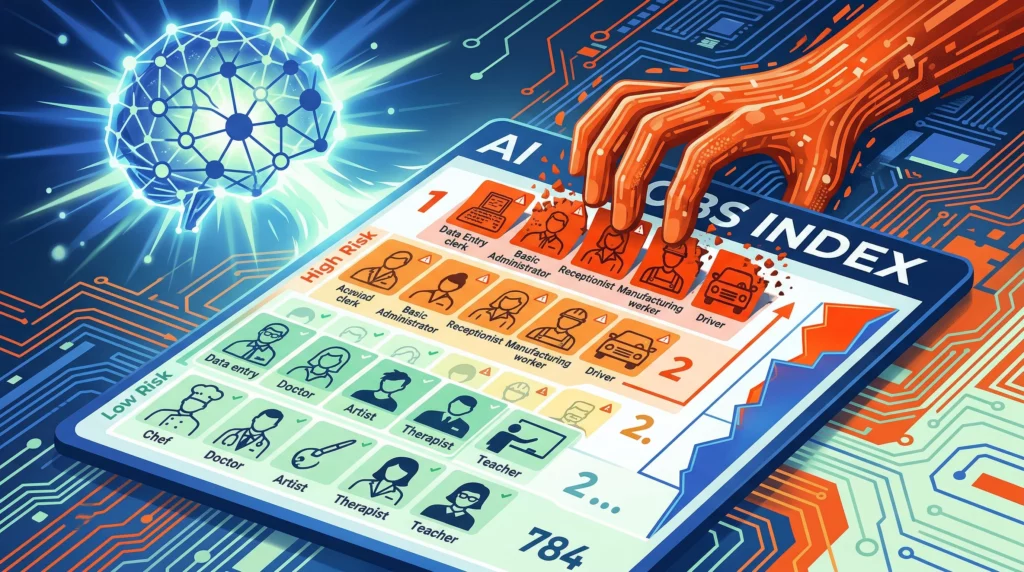
A new study released from Tufts University is gradually shedding light on a growing concern in workplaces. The question is how artificial intelligence could reshape jobs, not in theory, but in actual numbers?
The American AI Jobs Risk Index, which is created by researchers at the university’s Fletcher School, takes a close look at 784 occupations across the United States.
It ranks them based on how vulnerable these professions are to job losses as AI tools become more and more widely used. The study also tracks risk across regions, industries, and states. Individual studies offer a broad view of what may lie ahead.
Jobs Once Considered Safe Now in the Spotlight
Some of these roles mentioned in the study, topping this risk list can come as a surprise. Writers and authors are the most exposed, with a projected job loss risk of 57 percent.
Next and Close behind are computer programmers and web and digital interface designers, pegged at 55 percent.
Editors are not far off at 54 percent, while web developers stand at 46 percent. These are professions built on skill and expertise. Each of these professions also involve structured tasks that AI systems are increasingly able to handle.
The impact is not limited to these fields only. Marketing specialists, market research analysts, and public relations professionals all face notable levels of risk.
These risks range from 35 to 37 percent. Even journalists and news analysts are part of this shift, with a projected risk of 35 percent.
Not Layoffs Yet, But a Strong Signal
The numbers are not enough to reflect current job cuts. Instead, they are projections based on how quickly companies adopt AI tools.
Taking a middle-ground scenario, about 9.3 million jobs in the U.S. could be affected. In a slower adoption case, the number drops to 2.7 million. In a faster one, it could climb to 19.5 million.
This broad ranging shift shows just how uncertain the pace of change still is.
When Efficiency Comes at a Cost
One of the main ideas stated in the report is something researchers describe as a link between productivity and job loss.
As AI helps workers do more in less time, companies will not need as many people to produce the same output in the times to come.
This does not always mean sudden layoffs. In many cases, it may simply mean fewer new hires. Entry-level roles are likely to feel this first. The companies adjust hiring plans quietly rather than making drastic cuts, experts point out.
Fields like writing, coding, and data analysis are especially exposed because their tasks are often predictable and repeatable. These are exactly the kind of work AI tools are learning to handle well.
Industries Facing the Biggest Shift
On average, about 6 percent of jobs across industries are at risk. But some sectors stand out more than others. The Information sector leads with an 18 percent risk level. Finance and Insurance, along with Professional and Technical Services, follow at 16 percent each.
There is more than one financial angle to consider. Roles such as software developers and management analysts are not only widespread but also well-paid.
Together with market research analysts, they make up a large portion of the estimated $757 billion in annual income that could be affected.
An Incomplete but Important Picture
The study does not yet include jobs that AI might create in the future. The researchers say that part will come later, once there is clearer evidence. For now, the focus is on potential losses.
It also leaves out factors that could slow things down. These most definitely include regulations, union influence, or licensing rules in certain professions.
A Reality Check for the AI Era
For many professionals, there has been a belief that learning AI tools would make their roles more secure. This study challenges that given idea. In some cases, the very tools boosting productivity are reducing the need for larger teams.
The message is of adjustment but not fear and panic literally. As AI continues to evolve, the nature of work is likely to change alongside it.
The index will be updated over time, with future versions expected to include both job losses and job creation. Until then, it offers a clear, if uncomfortable, snapshot of where things may be headed.