All SEO
  SEO News
  SEO Strategy
  Ask An SEO
  Enterprise SEO
  Google Algorithm Updates
  International SEO
  Link Building
  Local SEO
  Mobile SEO
  On-Page SEO
  Technical SEO
  Vertical SEO
  Wordpress for SEO
  Web Dev for SEO
  SaaS SEO
  E-commerce SEO
  AI-Driven SEO
 Google Reveals Next Generation Of AI Search


Google reveals the next generation of AI-powered Search, featuring enhanced contextual understanding and faster responses to improve user experience.
VP of Product, Robby Stein, has detailed how the evolution of Google Search is converging with advanced AI technology built on three foundational pillars. This marks a transformative shift with profound implications for publishers, SEOs, and e-commerce businesses.
The Three Core Components of AI-Enhanced Search
Stein identifies three essential elements shaping the future of search:
- AI Overviews: Fast, natural language summaries that answer queries succinctly at the top of search results.
- Multimodal Search: Visual search powered by Google Lens, enabling users to query with images and videos.
- AI Mode: A conversational, turn-based search experience that synthesizes structured knowledge and web content into interactive dialogues.
These pillars will merge to create an integrated, intelligent search system that goes far beyond traditional keyword queries and static ten-blue-link listings.
Stein explains:
“I can tell you there’s kind of three big components to how we can think about AI search and kind of the next generation of search experiences. One is obviously AI overviews, which are the quick and fast AI you get at the top of the page many people have seen. And that’s obviously been something growing very, very quickly. This is when you ask a natural question, you put it into Google, you get this AI now. It’s really helpful for people.
The second is around multimodal. This is visual search and lens. That’s the other big piece. You go to the camera in the Google app, and that’s seeing a bunch of growth.
And then with AI mode, it brings it all together. It creates an end-to-end frontier search experience on state-of-the-art models to really truly let you ask anything of Google search.”
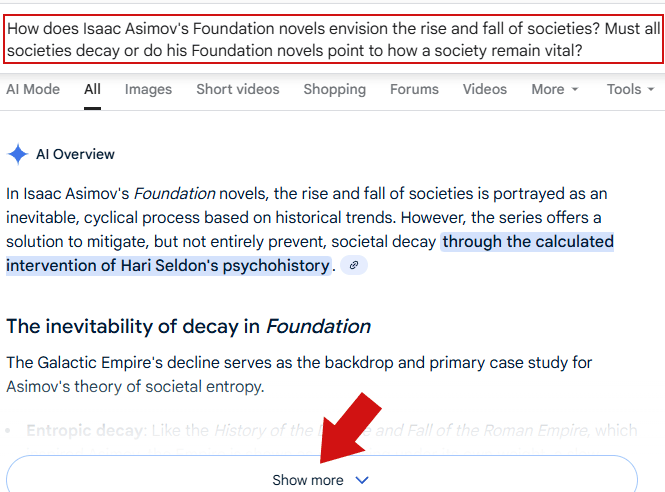
The screenshot above illustrates a complex two-sentence search query entered in Google’s search bar. This type of query automatically activates an AI Mode preview, featuring a “Show more” option that opens an immersive conversational search experience.
AI Mode: Google Search’s New “Brain”
Stein describes AI Mode as a radically different search experience, a “brain” capable of understanding and responding conversationally to complex user queries.
Stein explained this new concept as:
“You can go back and forth. You can have a conversation. And it taps into and is specially designed for search. So what does that mean? One of the cool things that I think it does is it’s able to understand all of this incredibly rich information that’s within Google.
- So there’s 50 billion products in the Google Shopping Graph, for instance. They’re updated 2 billion times an hour by merchants with live prices.
- You have 250 million places and maps.
- You have all of the finance information.
- And not to mention, you have the entire context of the web and how to connect to it so that you can get context, but then go deeper.
And you put all of that into this brain that is effectively this way to talk to Google and get at this knowledge.
That’s really what you can do now. So you can ask anything on your mind and it’ll use all of this information to hopefully give you super high quality and informed information as best as we can.”
AI Mode signals a transition from retrieval of links to generation of informed, interactive responses drawing on Google’s own structured data, knowledge graphs, and web content.
Complementing AI overviews and AI Mode, multimodal search leverages the camera and Google Lens to convert images into search inputs, powering discovery through visual prompts. Users can navigate fluidly between text and image queries for a richer information journey.
A Unified Search Experience on the Horizon
Responding to questions on integration, Stein said Google aims to merge these AI components into a single, seamless interface. This means whether users type, speak, or photograph a query, the same intelligent system will interpret intent, context, and deliver rich information.
Stein provided the following information:
“And you can use it directly at this google.com/ai, but it’s also been integrated into our core experiences, too. So we announced you can get to it really easily. You can ask follow-up questions of AI overviews right into AI mode now.
Same for the lens stuff, take a picture, takes it to AI mode. So you can ask follow-up questions and go there, too. So it’s increasingly an integrated experience into the core part of the product.”
The host of the podcast further asked for a clearer explanation of how all of these things will be integrated.
He asked:
“I imagine much of this is… wait and see how people use it. But what’s the vision of how all these things connect?
Is the idea to continue having this AI mode on the side, AI overviews at the top, and then this multimodal experience? Or is there a vision of somehow pushing these together even more over time?”
Stein replied that these modes of information discovery will converge. Google will be able to detect by the query whether to trigger AI Mode or just a simple search. There won’t be different interfaces, just the one.
Stein explained:
“I think there’s an opportunity for these to come closer together. I think that’s what AI Mode represents, at least for the core AI experiences. But I think of them as very complementary to the core search product.
And so you should be able to not have to think about where you’re asking a question. Ultimately, you just go to Google.
And today, if you put in whatever you want, we’re actually starting to use much of the power behind AI mode, right in AI Overviews. So you can just ask really hard, you could put a five-sentence question right into Google search.
You can try it. And then it should trigger AI at the top, it’s a preview. And then you can go deeper into AI mode and have this back and forth. So that’s how these things connect.
Same for your camera. So if you take a picture of something, like, what’s this plant? Or how do I buy these shoes? It should take you to an AI little preview. And then if you go deeper, again, it’s powered by AI mode. You can have that back and forth.
So you shouldn’t have to think about that. It should feel like a consistent, simple product experience, ultimately. But obviously, this is a new thing for us. And so we wanted to start it in a way that people could use and give us feedback with something like a direct entry point, like google.com/AI.”
For Publishers and SEOs
Publishers and SEOs must adapt to creating content that thrives within an interactive natural language environment, where content quality, context, and structured data are paramount.
Key considerations include:
- Creating unique, comprehensive content that fits into conversational AI answers
- Integrating multimedia content like images and video tutorials to align with multimodal search
- Understanding how AI systems interpret and surface information beyond traditional keyword optimization
Publishers and marketers will need to embrace these changes to maintain visibility and relevance as AI-driven search reshapes user behavior.Google’s vision for AI-powered search ushers in a new paradigm focusing on dialogue, depth, and multimodal interaction rather than static links.
This evolution requires businesses and content creators to rethink SEO strategies to align with rich AI interactions and integrated data environments.
Bottom Line
Brands that embrace this shift early will be best positioned to connect with users in more meaningful, context-aware ways as the future of search unfolds.
Watch the podcast interview with Robby Stein here: