All SEO
  SEO News
  SEO Strategy
  Ask An SEO
  Enterprise SEO
  Google Algorithm Updates
  International SEO
  Link Building
  Local SEO
  Mobile SEO
  On-Page SEO
  Technical SEO
  Vertical SEO
  Wordpress for SEO
  Web Dev for SEO
  SaaS SEO
  E-commerce SEO
  AI-Driven SEO
Eight Commonly Ignored Reasons Why Sites Lose Rankings In Core Updates


A breakdown of eight commonly ignored reasons websites lose rankings during Google core updates and how to identify them.
When rankings tank after a Google core update, it’s rarely just one obvious issue. Often, the update shifts how Google interprets intent, topical relevance, and authority relative to competing content, exposing weaknesses that standard SEO audits overlook. These eight factors help explain why seemingly “good” sites can still lose visibility.
1. The Site Was Over-Ranking Before
Sometimes a drop simply means the page is “ranking where it was supposed to rank” all along. An update can close a loophole or refine a relevance signal that had quietly been over-rewarding your content or links. From a publisher’s perspective, nothing changed on-site, but Google’s systems caught up and recalibrated the page to a more realistic position in the SERPs.
2. Topical Theming Became More Precise
Google has confirmed that core “topicality systems” play a role in ranking, helping determine what a page is about beyond keywords and links.
Google’s 2018 “Medic Update” put this aspect of the algorithm into the spotlight. Many sites that had previously ranked for medical-related keywords disappeared from search results after it became clear they focused on folk remedies rather than evidence-based medicine. The shift reflected Google’s more precise, topic-level understanding of search intent and subject matter.
Bill Slawski suggests that patent work on “website representation vectors” describes classifying sites by knowledge domain and expertise level such as prioritizing expert medical sites for clinical queries while excluding folk remedy pages.
The patent describes it as:
“The search system can use information for a search query to determine a particular website classification that is most responsive to the search query and select only search results with that particular website classification for a search results page. For example, in response to receipt of a query about a medical condition, the search system may select only websites in the first category, e.g., authored by experts, for a search results page.”
Beginning in 2018, Google shifted its definition of relevance toward topical authority, a focus that has been refined through subsequent updates. Rather than relying primarily on links and keyword overlap, Google developed systems to classify websites by knowledge domain, allowing it to better assess how content aligns with search intent.
In the case of medical queries, many sites lost visibility during the Medic Update because their content fell outside the medical and scientific knowledge domain.
Websites centered on folk or alternative remedies were effectively excluded from ranking for medical terms, regardless of their backlink profiles. Similar reclassifications have occurred across other subject areas and continue to influence rankings as Google’s understanding of topical relevance evolves.
Topical Theming Example
Topical themes are not static. For some queries, Google can pivot between informational and commercial intent depending on user context, past searches, location, device, and even time of day. A query like “bomber jacket” might skew toward shopping most of the time, but in some contexts it can surface more informational content first.
Alpha Industries ranks first in Google search results currently at the time of this writing. The brand’s strong association with military clothing stems not only from its focus on military-inspired apparel, but also from its origins as a contractor supplying garments to the U.S. military. As a result, both Google and consumers closely identify Alpha Industries with the military clothing category.
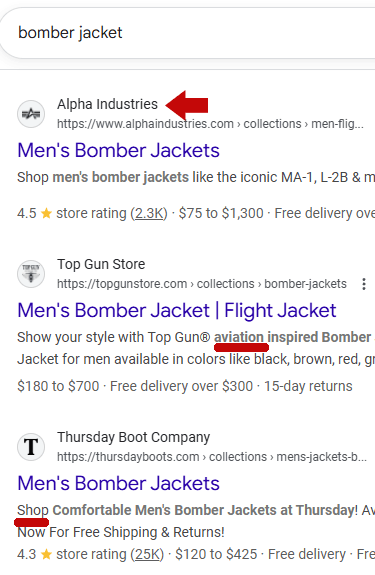
It is therefore unsurprising that Alpha Industries ranks first for “bomber jacket,” as it aligns strongly with both topical themes associated with the query:
- Shopping > Military clothing
- Shopping > Men’s clothing
If a page that previously ranked no longer does, it may indicate that Google has more narrowly defined the topical focus of the query. The practical way to assess this is by reviewing the highest-ranking results and comparing their thematic alignment typically across positions one and two, or in some cases the top three or top five listings, depending on how tightly the topic is defined.
In the bomber jacket example, positions one through three are primarily themed around “military clothing” and “men’s clothing.” The site ranking third, Thursday Boot Company, aligns more closely with men’s fashion than with military apparel. Notably, the brand itself is strongly associated with men’s clothing.
This type of SERP analysis helps explain why certain sites rank while others lose visibility.
3. Intent And Topic Personalization Shifted
Topical themes aren’t always fixed because user intent can shift. Performing the same search in a new browser or a different tab may cause Google to adjust the dominant topical theme based on intent.
For example, the “bomber jacket” search results can sometimes be organized as:
- Informational > Article About Bomber Jackets
- Shopping > Military clothing
- Shopping > Men’s clothing
This variation reflects the user’s underlying information need, which determines the intent and relevant topic. In this case, the military clothing theme may represent the primary intent, but informational or discovery-focused intent can also influence the results. Factors such as prior searches, geographic location, device type, and even time of day can affect which theme dominates.
The key takeaway is that a site may not be underperforming it might simply be ranking for a narrower or different topical intent. If personalization or shifting intent causes your page to drop, a practical approach is to create additional content targeting the alternative topical theme that Google is prioritizing.
4. Authoritativeness Is Externally Validated
Authoritativeness can be understood as external validation of a website’s expertise on a product, service, or content topic. While an author’s expertise contributes to it, and some level of authoritativeness may be inherent to the website itself, it is ultimately third-party recognition through citations, links, and endorsements from readers, customers, or other websites that signals authoritativeness to Google.
This concept can be summarized in four points:
- Expertise and topical focus originate within the website.
- Authoritativeness reflects recognition of that expertise.
- Google does not directly measure this recognition.
- Third-party signals validate a site’s authoritativeness.
Additionally, Google’s Website Representation Vector patent demonstrates how the search engine can identify both expertise and authoritativeness. In practice, Google first selects relevant content and then filters it further by prioritizing material deemed to be from authoritative, expert sources.
Google explains how it uses E-E-A-T in the following manner:
“Google’s automated systems are designed to use many different factors to rank great content. After identifying relevant content, our systems aim to prioritize those that seem most helpful. To do this, they identify a mix of factors that can help determine which content demonstrates aspects of experience, expertise, authoritativeness, and trustworthiness, or what we call E-E-A-T.”
Authoritativeness isn’t determined by how frequently a site publishes on a topic as any spammer can churn out content. True authority goes beyond volume. E-E-A-T serves as the standard for evaluating a site’s credibility and expertise.
5. You Can’t “Add” E‑E‑A‑T As A Checklist
At Search Central Live NYC, John Mueller reiterated that E‑E‑A‑T is not something SEOs can “add” to a page like schema or internal links.
He said:
“Sometimes SEOs come to us or like mention that they’ve added EEAT to their web pages. That’s not how it works. Sorry, you can’t sprinkle some experiences on your web pages. It’s like, that doesn’t make any sense.”
Content can reflect authoritativeness, trustworthiness, expertise, and experience, but these qualities aren’t something you simply add to a page. So what are they?
E-E-A-T serves as a standard for evaluating your site, but it’s also a subjective judgment made by visitors similar to how one person might consider a sandwich “great.” It’s a matter of perception and opinion.
A common challenge for SEOs is identifying why content that seems equally strong as competitors still fails to reach the first page of the SERPs. Often, the difference is that top-ranking pages are optimized for people, not just algorithms. Many high-ranking sites also employ a multimodal content strategy using images, video, and other formats, whereas page-two sites rely primarily on text.
Even in SERPs dominated by government or educational sites, the commercial pages that break through typically demonstrate content and outreach that resonate with users in ways competitors’ sites do not. Sites that prioritize people-focused, multimodal experiences are often the ones that outperform others.
If your site is stuck on page two, study the top-ranking pages closely. Look at how they engage users, the types of content they include, and how they provide a richer experience. You may discover the key elements that make their pages resonate and identify ways to apply similar strategies to your own content.
6. Early Rankings Were Temporary “Tests”
New sites and fresh pages often see a short‑term visibility boost as Google “tastes” them to see how they perform alongside established content. When that honeymoon ends, rankings can drop sharply—not as a penalty, but as a reversion to where the page fits once longer‑term signals and comparisons are factored in.
This pattern can be especially confusing if the initial performance looked strong. But long‑term placement has to be earned through sustained usefulness, engagement, and recognition relative to competing pages, not just initial freshness.
7. Competitors Quietly Got Better
In many core updates, nothing is “wrong” with the losing site; competitors simply became better matches for user needs in subtle ways. Those differences can include:
- Richer, more practical content experiences (copy, imagery, structure).
- Stronger multimodal mix (video, tools, calculators, downloads).
- Better UX and perceived trust (e.g., social proof, clearer positioning).
- Offline and brand efforts that drive more direct, navigational, and branded search demand.
Because these improvements often live outside traditional SEO levers, audits that only poke at technical details or backlinks can miss why the gap opened up.
8. The Site Isn’t Truly Optimized For People
Optimizing for people is often overlooked, yet it’s a key part of conversion optimization. At its core, conversion optimization focuses on subtle signals that show a webpage meets the visitor’s needs. Sometimes those needs are about recognition and reassurance letting visitors know you’re available, trustworthy, or credible.
For example, one client displayed a badge at the top of their page stating, “Trusted by over 200 of the Fortune 500.” This quietly signaled legitimacy and trustworthiness. Another client realized most of their visitors were mothers of boys, so they prioritized images showing mothers with sons, subtly acknowledging and resonating with their audience.
People don’t love a site simply because it’s heavily SEO-optimized they respond to sites that acknowledge them in meaningful ways. This “invisible” layer of human-centered optimization often gives sites an edge over competitors.
Rather than copying competitors, focus on differentiation: make your site and outreach stand out in ways that genuinely connect with users. Outreach means identifying where your audience spends time and tailoring your message to engage them effectively.
Third-party signals what people and other sites say about you have long been important ranking factors, and with AI-driven search, these endorsements are increasingly influencing rankings.
Key Takeaways from Core Updates
- Core updates may correct over-ranking rather than penalize sites.
Ranking drops often reflect Google closing loopholes and placing pages where they should have been all along, rather than exposing new problems. - Topical theming has become more precise.
Google increasingly evaluates content based on topical categories and user intent, not just keywords or links, making existing algorithms more refined. - Topical themes can shift dynamically.
Search results may vary between informational and commercial intent depending on context, such as prior searches, location, device, or time of day. - Authoritativeness is externally validated.
Recognition through users, citations, links, and broader awareness often determines why one site ranks higher than another. - SEO cannot directly control E-E-A-T.
Expertise and authoritativeness are inferred from external signals rather than being something SEOs can add to content. - Temporary ranking boosts are normal.
New pages and sites may receive brief visibility before needing sustained performance to secure long-term placement. - Competitors may simply be better for users.
Ranking losses often occur because competitors provide subtle but meaningful advantages, not because a site is inherently broken. - People-first optimization is a competitive edge.
Pages that emotionally, visually, and practically resonate with visitors frequently outperform sites optimized purely for SEO. - Ranking shifts often reflect clearer assessments of relevance and usefulness.
As Google refines its understanding of topics, pages increasingly compete on alignment with user goals and recognition by trusted sources.
The lasting advantage comes from building a site that genuinely resonates with users, earns attention beyond search, and provides consistent signals of preference to Google. Traditional marketing, actively letting people know about your business, remains an essential part of supporting SEO and authority.