All SEO
  SEO News
  SEO Strategy
  Ask An SEO
  Enterprise SEO
  Google Algorithm Updates
  International SEO
  Link Building
  Local SEO
  Mobile SEO
  On-Page SEO
  Technical SEO
  Vertical SEO
  Wordpress for SEO
  Web Dev for SEO
  SaaS SEO
  E-commerce SEO
  AI-Driven SEO
 Meta Will Use AI Interactions To Improve Ad Targeting


Meta plans to use user interactions with its AI tools to refine ad targeting, aiming to deliver more personalized and relevant advertising experiences.
Meta has announced that, starting December 16, 2025, it will use users’ interactions with its AI tools. This will include chat and voice commands to customize content and advertise across its platforms, including Facebook, Instagram, Threads, and WhatsApp.
Meta AI Data Enhances Personalization
This update aims to make ads and recommended content more relevant to users based on their conversations with Meta AI.
According to Meta:
“More than 1 billion people use Meta AI every month. We’re continuing to improve the way our AI products feel relevant to you, understand your goals, and help you accomplish tasks more efficiently. We’re also using Meta AI, and our other AI features, to improve your experience on all of our platforms. We will soon use your interactions with AI at Meta to personalize the content and ads you see, including things like posts and reels. We’ll start notifying people about this update next week via notifications and emails, several weeks before it goes into effect on December 16, 2025.”
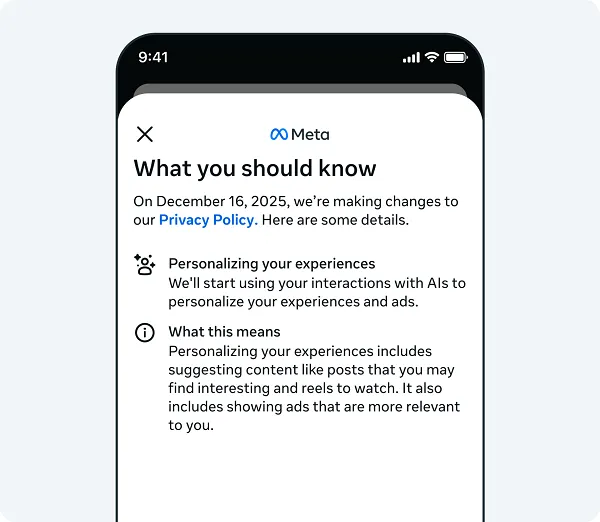
So, when you start a conversation with Meta AI about hiking, it will understand that you are interested in hiking, and you will be shown hiking-related groups, posts, or ads for hiking shoes.
Meta promises users that it will not target ads based on information about conversations it deems sensitive, such as religion or belief, political opinion, sexual orientation, health, race or ethnic origin, philosophical belief, or trade union membership.
Meta will restrict interactions so that data from AI on one App (e.g., WhatsApp) cannot be used to inform experiences in others unless those accounts have been linked via Meta’s Accounts Center.
User Control and Transparency
Transparency about the change will be provided to users on Meta platforms through emails and in-app notifications, which the company will roll out as of early October 2025, ahead of the implementation.
The company emphasized users can still manage that with tools like Ad Preferences, privacy settings, and the ability to set how AI features respond when using voice or text.
Meta emphasizes:
“Whether it’s a voice chat or a text exchange with our AI features, this update will help us improve the recommendations we provide for people across our platforms so they’re more likely to see content they’re actually interested in – and less of the content they’re not. For example, if you chat with Meta AI about hiking, we may learn that you’re interested in hiking – just as we would if you posted a reel about hiking or liked a hiking-related Page. As a result, you might start seeing recommendations for hiking groups, posts from friends about trails, or ads for hiking boots.”
If this announcement had been from OpenAI instead, they probably would have created much more anxiety, simply because of how personally people engage with ChatGPT. However, because it is not as personal as an OpenAI chat, the reaction will likely be overall nothing more than a yawn.
Although Meta AI chats would be public, various queries could raise concerns. Additionally, any prompts you enter into Meta’s image generator to create content will now be governed by this data usage policy.
Therefore, choose your prompts wisely, unless you don’t mind seeing ads about them later. But for advertisers, this change could provide a key new data stream, allowing audiences to be targeted much more accurately as their interests change in real-time.
If Meta actually manages to get its users to search for things to purchase or services to use via its chatbot. In that case, it can end up creating the most enormous trove of behavioral data and effectively supersize ad targeting with the latest and most relevant promotions.
Final Thoughts
There will always be privacy critics who will view this end-run of AI interactions as a means of driving targeted advertising. Still, this change appears to be a perfectly reasonable next step in Meta’s personalization strategy, aimed at providing users with more relevant content and, in turn, better business outcomes.