All SEO
  SEO News
  SEO Strategy
  Ask An SEO
  Enterprise SEO
  Google Algorithm Updates
  International SEO
  Link Building
  Local SEO
  Mobile SEO
  On-Page SEO
  Technical SEO
  Vertical SEO
  Wordpress for SEO
  Web Dev for SEO
  SaaS SEO
  E-commerce SEO
  AI-Driven SEO
 Meta Rolls Out Changes to Its Ad Billing Settings 2025


Meta has introduced changes to its Ad billing settings that give marketers more control and flexibility in their payment options and budget management.
Meta has quietly implemented a few modifications to its Ad billing system and budget management. These are changes which could impact your campaign’s costs as well as overall efficiency and give marketers more control and flexibility with regard to their payment options and managing their budgets.
Upfront Billing Now Standard
Meta has recently updated its ad billing by changing the wording of its overview of how and when you’ll be charged for Meta ads, now explicitly stating that upfront billing is in effect.
In the past, the platform billed advertisers each time their ad expenditure exceeded a certain threshold for payment and any additional costs were charged on a monthly statement.
Today, Meta’s revised policy stipulates:
“You’re charged at the moment you confirm your ads purchase. Your ads charge will be equal to the budget your set for your ad and we will not charge you an amount exceeding the budget that you set for your ad. For example, if your campaign is set to run for two days with a daily budget of $10, you’ll be charged $20 at the moment you confirm your purchase.”
The change means that advertisers are now charged the entire budget at the beginning, and not waiting for delivery of ads to reach spending thresholds. Although Meta is likely to be confident about its ability to deliver ads but this could lead to increased upfront costs as well as less freedom for campaigns that fail to perform or don’t reach their budgets.
Spending Limits for Advantage+ Campaigns
Meta has also changed budget control in its Advantage+ Automated campaigns. Instead of defining the budget limit for maximum and minimum, advertisers have now defined an average ad set spending limit.
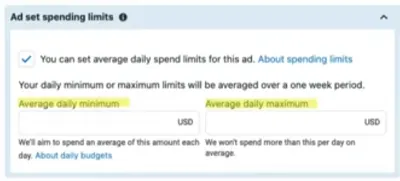
This means that the system will limit spending to a maximum amount over the course of the entire campaign, instead of constantly adjusting spending in accordance with daily engagement and performance variations.
Meta advertising Specialist Jon Loomer describes this change as unusual and warns that it could limit the optimization of performance typically provided by Meta’s automated ad delivery tools. The new method could appeal to advertisers looking for more control over their budgets, which will reduce the risk of unexpected surprises if spending per day approaches or exceeds certain thresholds.
Bottom Line
The bottom line is that these changes are created to provide advertisers with more confidence in spending limits, particularly for those who are hesitant to completely trust the automated allocation. However, restricting budgets in such a way could limit the effectiveness of campaigns, and it is important to know the pros and cons before signing up.