All SEO
  SEO News
  SEO Strategy
  Ask An SEO
  Enterprise SEO
  Google Algorithm Updates
  International SEO
  Link Building
  Local SEO
  Mobile SEO
  On-Page SEO
  Technical SEO
  Vertical SEO
  Wordpress for SEO
  Web Dev for SEO
  SaaS SEO
  E-commerce SEO
  AI-Driven SEO
 LinkedIn Shares Branding Pointers for B2B Businesses


LinkedIn shares new branding pointers for B2B businesses, outlining strategies to strengthen brand identity, boost visibility, and drive effective engagement.
LinkedIn has released a new B2B Institute guide on effective branding, with a clear focus on making your business easier to find, not just easier to remember. Produced with the Ehrenberg-Bass Institute, the 55-page report digs into how presence, prominence and portfolio strategy drive B2B growth, especially at key buying moments.
Physical Availability For B2B: “Easy To Find, Easy To Buy”
The guide, “Easy to Find: Being Where B2B Buying Happens,” builds on Ehrenberg-Bass research into mental and physical availability and applies it to complex B2B buying journeys.
According to LinkedIn:
“Just like shelf space is key to being purchased in B2C, B2B growth depends on maintaining a consistent, credible, and contextual presence across both digital and human touchpoints. Drawing on the Ehrenberg-Bass Institute’s research and LinkedIn’s experience with thousands of global B2B advertisers, the [report details] why physical availability shouldn’t be treated as a nice-to-have, tacked on at the end of planning, but instead as a critical component of growth. And, we’re not just making the case, we’re pointing marketers to where they should focus.”
Three Pillars: Presence, Prominence, Portfolio
The report structures its advice around three main levers:
- Presence – Being visible in the channels where customers actively look and buy
- Prominence – Making your brand easy to find and recognize
- Portfolio – Aligning what you sell with where real demand and profit sit
The core idea is simple: don’t just build awareness, architect how and where buyers encounter your brand when decisions are made.
Presence: Show Up Where Revenue Actually Flows
On presence, LinkedIn and Ehrenberg-Bass urge marketers to map channel strategy to actual revenue contribution, not internal habit.
This is the guidance:
“Covering revenue means establishing presence in line with the channel’s value contribution to category transactions. Compare the revenue of the total category business that comes through each sales channel to the share of your brand’s business that comes through that channel. For example, if 30% of category revenue comes via brand websites, then your brand should have 30% of its revenue via its website.”
That thinking extends beyond digital into trade shows, events and other offline touchpoints, with the report emphasizing that B2B brands need to research their category, understand where decision-makers genuinely shop and learn, then weight investment toward those environments.
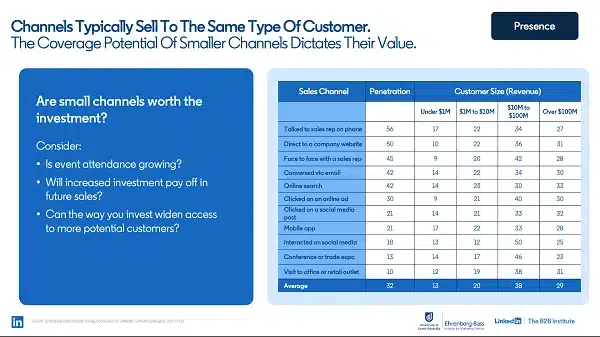
In practice, that means using sales and penetration data, not just media reach, as your starting point for channel planning.
Prominence: Move From “Rented” To “Owned” Visibility
For prominence, the guide warns against an overreliance on “rented” exposure things like paid search or sponsored placements that disappear as budgets do.
LinkedIn draws a property analogy:
“Just as renting property offers immediate access to a prime location but with little long-term security, many B2B brands rely heavily on rented brand prominence (e.g., sponsored search ads) to stand out in a crowded and complex marketplace. Rented prominence is a quick fix, or a short-term lease, on brand visibility. But, without a plan to transition toward owned prominence (e.g., thought leadership, community engagement, strong brand associations), brands risk being evicted from prime real estate the moment budgets tighten, or competitors outbid them.”
To mitigate that risk, LinkedIn recommends investing in more durable assets as distinctive visual identity, recognizable brand codes, thought leadership content, and community or partner ecosystems that keep you visible even when your paid media is dark.
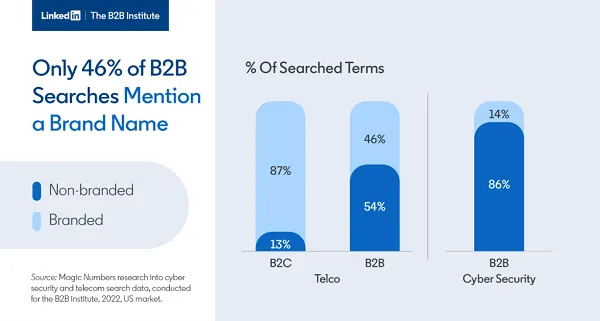
The guide also points to LinkedIn research on shifting B2B discovery habits to help marketers see where owned prominence (like consistent content and communities) can complement rented reach.
Portfolio: Protect The Core, Then Optimize Around It
The “portfolio” section focuses on what you actually put on the proverbial shelf your core products and services.
As the guide explains:
“Good portfolio management is knowing, protecting, and investing in the core product/service, the one that contributes the most to the brand/company’s top and bottom line. Protecting the core is about protecting current and future revenue. It is important to ensure any marketing decision ‘does no harm’ to what is currently the most important company revenue source.”
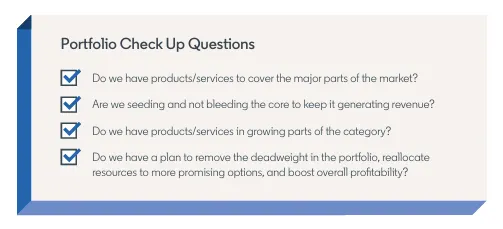
That means using sales and customer data to identify the SKUs or services that really drive profit, making sure they’re easy to discover and buy, and avoiding brand or messaging moves that confuse or dilute them.
From there, marketers can trim low-impact offerings and scale new bets once they show genuine traction, instead of spreading resources thinly across a bloated portfolio.
Final Thought
If you are looking to reset your B2B strategy next year, this guide is worth a careful read, and a good prompt to audit where your brand is truly “on the shelf” when your buyers go to look.
You can download LinkedIn’s “Easy to Find: Where B2B Buying Happens” report here.