All SEO
  SEO News
  SEO Strategy
  Ask An SEO
  Enterprise SEO
  Google Algorithm Updates
  International SEO
  Link Building
  Local SEO
  Mobile SEO
  On-Page SEO
  Technical SEO
  Vertical SEO
  Wordpress for SEO
  Web Dev for SEO
  SaaS SEO
  E-commerce SEO
  AI-Driven SEO
 Internal Documents Reveal That Meta is Earning Billions from Scam Ads


Internal documents reveal that Meta is earning billions from scam ads running across its platforms, raising concerns over ad integrity and user safety.
Internal documents obtained by Reuters reveal a troubling reality for Meta Platforms Inc. The company estimates that roughly 10% of its total annual revenue in 2024 approximately $16 billion comes from scam ads and promotions for banned goods running across its platforms, including Facebook and Instagram.
Scope of Scam Ad Activity on Meta’s Platforms
As reported by Reuters:
“On average, one December 2024 document notes, the company shows its platforms’ users an estimated 15 billion ‘higher risk’ scam advertisements – those that show clear signs of being fraudulent – every day.”
These ads, which clearly signal fraudulent activity, include deceptive e-commerce operations, fake investment schemes, illegal online casinos, and the sales of banned medical products.
Besides these paid scams, an additional 22 billion organic scam attempts are reportedly detected daily, illuminating the staggering scale of fraudulent content on Meta’s ecosystem.
Revenue Incentives and Limited Enforcement
Significantly, the internal data suggests Meta actively tolerates a large volume of these scams because of the substantial revenue they generate.
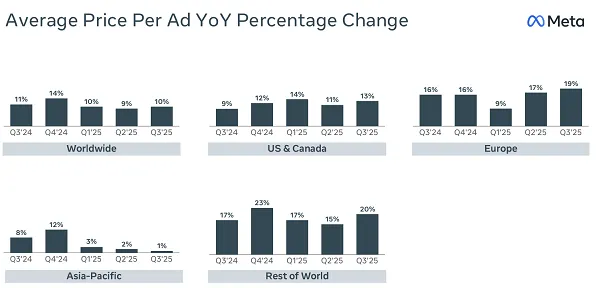
Meta’s ad costs are increasing, reflecting higher demand across its platform. This suggests that beyond the direct revenue Meta earns from scam ads, their presence may also be inflating ad prices for all advertisers potentially allowing Meta to generate significantly more overall revenue from this factor.
“The documents further note that users who click on scam ads are likely to see more of them because of Meta’s ad-personalization system, which tries to deliver ads based on a user’s interests.”
Meta reportedly enforces a policy of banning suspicious advertisers only when its automated systems reach 95% confidence that an ad is fraudulent.
For cases below this threshold, Meta imposes “Penalty Bids,” increasing ad costs for potentially fraudulent ads, which acts as a soft deterrent but does not fully prevent scam ads from running.
Impact on Advertisers and Users
The presence of scam ads affects the entire advertising ecosystem on Meta’s platforms. Rising competition from fraudulent advertisers drives up ad prices, increasing costs for legitimate businesses and eroding confidence in the platform’s advertising quality.
Meanwhile, users who engage with scam ads are more likely to be targeted with additional scams due to Meta’s ad personalization algorithms, leading to a degrading user experience.
Rising Regulatory Scrutiny Amid Growing Scam Losses Globally
Scams are a significant global problem, with the Global Anti-Scam Alliance reporting over a trillion dollars lost worldwide last year.
According to its “2025 Global State of Scams” report, around 23% of adults globally have lost money to scams, with higher rates in regions such as South America and Africa.
Given Meta’s global footprint, regulatory bodies across multiple regions are expected to investigate these revelations closely.
Meta’s Response and Continuing Challenges
Meta has disputed the report’s interpretation of its internal data, stating that the statistics are a “selective view” that misrepresent the company’s anti-fraud efforts.
The company highlights that evolving scam detection measures have reduced user reports of scam ads by 58% in 2025, suggesting improvement.
However, these claims face skepticism amid the documents’ implications of tolerated scam ad volumes.
Reputation Risks and Potential Consequences
This disclosure deals a serious blow to Meta’s reputation, highlighting ethical challenges and potential risks of regulatory penalties if claims are substantiated.
The financial incentives to allow scam ads, combined with rising enforcement focus, could affect Meta’s advertising business and slow investment in future technologies.
The dynamics between ongoing regulatory scrutiny and Meta’s financial interests will be key to monitoring in the coming months.
Bottom Line
The scale of scam advertising embedded within Meta’s revenue streams serves as a cautionary aspect for the broader digital advertising landscape which highlights the need for stronger platform accountability in future.