Google CEO Sundar Pichai Reveals Information Ecosystem Is Richer Than AI

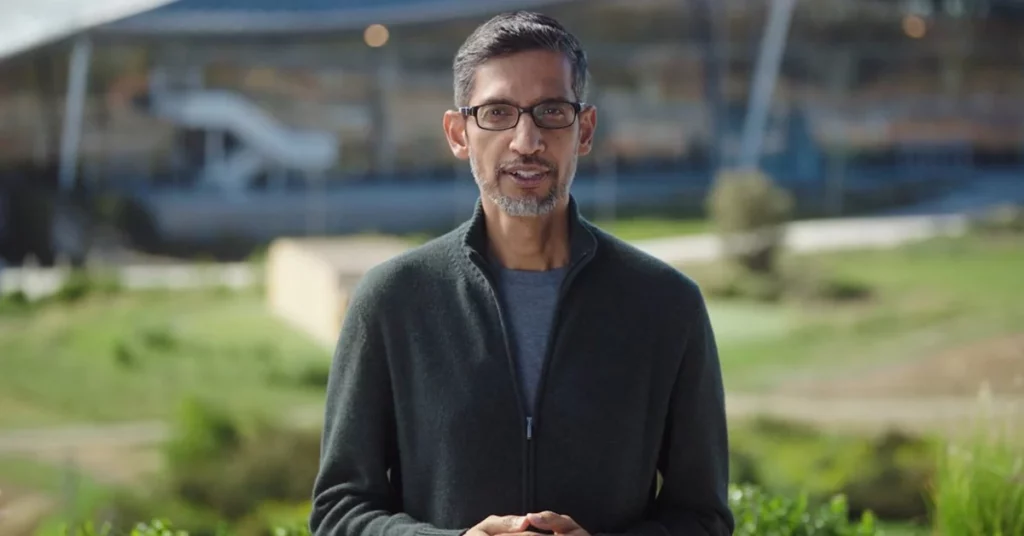
Google CEO Sundar Pichai reveals information ecosystem is richer than AI, highlighting the importance of human expertise, and trusted content in search.
Google CEO Sundar Pichai is drawing a clear line between what AI can do well and what it should never replace, stressing that generative AI is only one tool inside a much richer information ecosystem that still depends on search, journalism, and human experts.
AI Needs Grounding, Not Blind Trust
His recent BBC interview, widely reduced to “Don’t blindly trust what AI tells you,” has been mischaracterized in some headlines and social posts, missing his main point that AI should be grounded in real-world information, not treated as a standalone source of truth.
HTML Image 1
In the interview, Pichai was pressed on a simple but loaded question: does Gemini, Google’s ChatGPT-style assistant, always tell the truth?
He responded by explaining that generative AI models work by predicting likely next words, which means they are inherently “prone to errors,” and that’s exactly why Google is investing heavily in grounding them with real-world data via Google Search and other systems.
As he put it, Google is “working hard from a scientific standpoint to ground [AI] in real world information,” using Search as a tool to improve factual accuracy while acknowledging that the underlying models remain probabilistic.
That nuance often got lost in summary posts that made it sound as if he was simply warning people not to trust AI, rather than explaining why grounding and verification layers are essential to how Google wants AI to be used.
Use Each Tool For What It’s Good At
Pichai repeatedly emphasized that AI and Search are complementary, not interchangeable. Search, he said, is “more grounded in providing accurate information,” while generative AI shines for tasks like creative writing, ideation, or exploring possibilities where a single definitive answer may not exist.
His advice was straightforward: “use these tools for what they’re good at and not blindly trust everything they say,” a line that acknowledges both the power and the limits of current AI systems.
In practice, that means leaning on Search, documentation, and expert sources for factual checks, and using AI as a helper for drafting, summarizing, or exploring options especially in its current state of development.
AI Lives Inside A Larger Information ‘Forest’
Throughout the conversation, the interviewer kept zooming in on AI alone asking whether AI is reliable, whether it makes information less trustworthy, and whether Google bears special responsibility because transformer models originated there.
Pichai pushed back on that framing by zooming out, repeatedly reminding that AI is just one “tree” inside a much broader information “forest” that includes search engines, newsrooms, teachers, doctors, and other domain experts.
“So all of the hopes, the hype, the valuations, the social benefit of this transformation you’ve just described, you’ve built on a central assumption that the technology functions, that it works.
Let me propose one simple test of Gemini, which is your booming ChatGPT kind of competitor. Is it accurate always? Does it tell the truth?”
Pichai noted that generative AI isn’t a source of truth, it’s essentially making statistical predictions to form a response. That’s why Google Search plays a critical role in grounding AI, anchoring outputs in real-world facts rather than relying solely on training data.
He added:
“Look, we are working hard from a scientific standpoint to ground it in real world information. And there are areas, part of what we’ve done with Gemini is we’ve brought the power of Google Search. So it uses Google Search as a tool to try and answer, to give answers more accurately. But there are moments, these AI models fundamentally have a technology by which they’re predicting what’s next, and they are prone to errors.”
Use Tools for Their Intended Purpose
Pichai emphasized that AI and Search serve different roles, and neither replaces the other. His point was that users should rely on each tool for “what they’re good at,” rather than treating AI as a standalone replacement for Search.
Pichai explained:
“Today, I think, we take pride in the amount of work we put in to give as accurate information as possible. But the current state-of-the-art AI technology is prone to some errors.
This is why people also use Google Search, and we have other products which are more grounded in providing accurate information, right? But the same tools are helpful if you want to creatively write something.
So you have to learn to use these tools for what they’re good at and not blindly trust everything they say.”
The Broader Information Ecosystem Matters
When pressed again on reliability, the interviewer repeated Pichai’s point about not blindly trusting AI.
The interviewer asked:
“OK, don’t blindly trust.
But let me suggest to you that you have a special responsibility because this whole model, type of model, transformer model, the T in ChatGPT, was invented here under you. And you know that it’s a probability. And I just wonder if you accept the end result of all this fantastic investment is the information is less reliable?”
Pichai reiterated that Generative AI is only one piece of a much larger information ecosystem that also includes authoritative sources and human experts. While the interviewer tried to keep the focus strictly on AI, Pichai emphasized that it shouldn’t be viewed in isolation.
Pichai explained:
“I think if you only construct systems standalone, and you only rely on that, that would be true.
Which is why I think we have to make the information ecosystem… has to be much richer than just having AI technology being the sole product in it.
…Truth matters. Journalism matters. All of the surrounding things we have today matters, right?
So if you’re a student, you’re talking to your teacher.
If as a consumer, you’re going to a doctor, you want to trust your doctor.
Yeah, all of that matters.”
Pichai’s core message is that AI operates within a broader ecosystem of tools, human expertise, and verified knowledge not as a replacement for them. His references to teachers, doctors, and journalists underscore that human judgment remains the gold standard for accuracy.
Rather than treating AI as the sole source of answers, he repeatedly emphasized that it’s just one contributor to how people access information.
That’s why his comments can’t be boiled down to a simple headline like “Don’t blindly trust AI.” The deeper point is that, for Pichai and Google, AI is one tool among many in the larger information landscape.
What This Tells Us About Google’s View Of AI
Taken together, Pichai’s comments reinforce a consistent Google narrative that AI is a powerful layer on top of existing products, but it isn’t meant to replace Search or human experts as the final arbiter of truth.
Google’s current approach hinges on grounding AI responses in live web data, preserving visibility for publishers and professionals, and encouraging users to treat AI outputs as starting points rather than unquestionable answers.
For marketers, SEOs, and publishers, the subtext is important. Google still sees the “information ecosystem” as central: high-quality content, credible journalism, expert commentary, and authoritative sites continue to matter, not just as training data, but as destinations users should visit and trust.
Bottom Line
AI may change how that information is accessed and summarized, but in Google’s own framing, it does not replace the underlying ecosystem that produces it.
Watch the detailed interview here:
Video 1