Google AI Mode Goes Personal, Crawl Limits Clarified Ravi Gupta

Google is now changing the way how its search feature works, and the effects of this are starting to show. The latest updates reveal a move toward more personalised results, one which shows a rethink of technical limits, and puts growing pressure on publishers.
Together, these changes point to a search landscape that is less predictable and more fragmented than ever seen before.
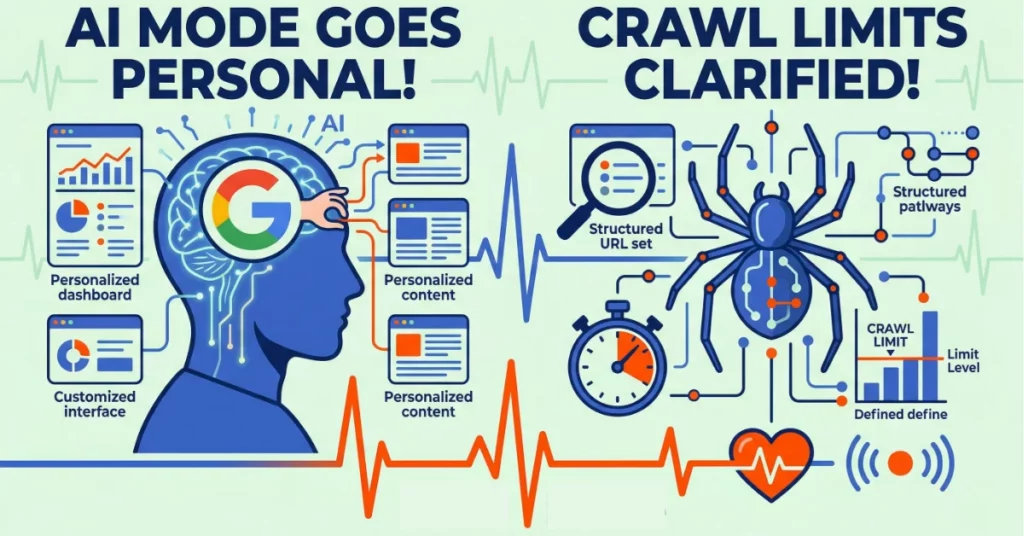
Personal AI Now Reaches Free Users
Google has opened up its Personal Intelligence feature to free users in the United States. Earlier, it was only available to those paying for premium AI plans.
This feature connects services like Gmail and Google Photos to AI Mode and allows search responses to pull in personal details such as bookings, emails, and images.
This rollout is underway on the Gemini app and Chrome. For now, it remains limited to personal accounts in the US, with no update on a wider release worldwide.
Search Results Will Now Vary More
This shift changes the basic idea of search in results. Two people typing the same query may now see different answers.
That is because AI Mode can tailor responses using personal data. For anyone working in SEO, this creates a new challenge and becomes harder to check what is actually ranking for a keyword in a consistent way.
Google Says Crawl Limits Are Not Fixed
Google has also clarified how its crawler handles page size. For years, the 15MB limit has been treated as a rule.
Now, that assumption looks shaky.
Google’s Gary Illyes and Martin Splitt explained that this limit can be adjusted internally. In real-world use, Google Search often works with a much smaller size, closer to 2MB.
Why This Detail Matters?
Most websites will not notice a difference. But pages packed with scripts or large chunks of data could run into issues.
The update suggests that efficiency matters more than hitting a specific number on your webpage. Keeping pages clean and lightweight remains the safer approach.
AI Overviews Are Taking Away Clicks
New research from SISTRIX shows how AI Overviews are changing user behaviour. The study analyzed over 100 million search queries in Germany.
When an AI Overview appears, the top organic result sees its click rate drop from 27% to 11%.
That is a steep fall.
AI Overviews now appear in about one in five searches in Germany, and their presence is growing.
Not Just a Local Trend
Similar patterns have already been seen in the US. Informational searches are hit the hardest, as users often get what they need directly from the AI summary.
This leaves fewer reasons to click through to websites.
Smaller Publishers Are Losing Ground
Data from Chartbeat paints a clear picture of how traffic is shifting.
Small publishers have lost around 60% of their search traffic over the past two years. Mid-sized publishers are down 47%, while larger brands have seen a smaller drop of 22%.
Traffic from Google Discover has also declined.
AI Traffic Is Still Too Small
Platforms like ChatGPT are sending more visitors than before, but the numbers remain tiny. They account for less than 1% of total page views in this data.
Bigger publishers are coping better by leaning on direct traffic, apps, and newsletters. Smaller outlets do not always have those options.
Search Is Becoming Harder to Measure
The common thread across all these updates is uncertainty.
Search results are no longer the same for everyone. AI is answering more queries directly. Technical guidelines are less rigid than they once seemed.
For anyone tracking performance, broad benchmarks are losing value. What works for one site may not apply to another.
Search is still evolving, but one thing is clear. It is no longer a level playing field, and adapting to these shifts will take closer attention than ever before.