All SEO
  SEO News
  SEO Strategy
  Ask An SEO
  Enterprise SEO
  Google Algorithm Updates
  International SEO
  Link Building
  Local SEO
  Mobile SEO
  On-Page SEO
  Technical SEO
  Vertical SEO
  Wordpress for SEO
  Web Dev for SEO
  SaaS SEO
  E-commerce SEO
  AI-Driven SEO
 3 CMS Platforms Now Shape How SEO Works Across the Web

A Quiet Shift in Power
A small group of website platforms is going on to quietly shaping how much of the internet performs in search results.
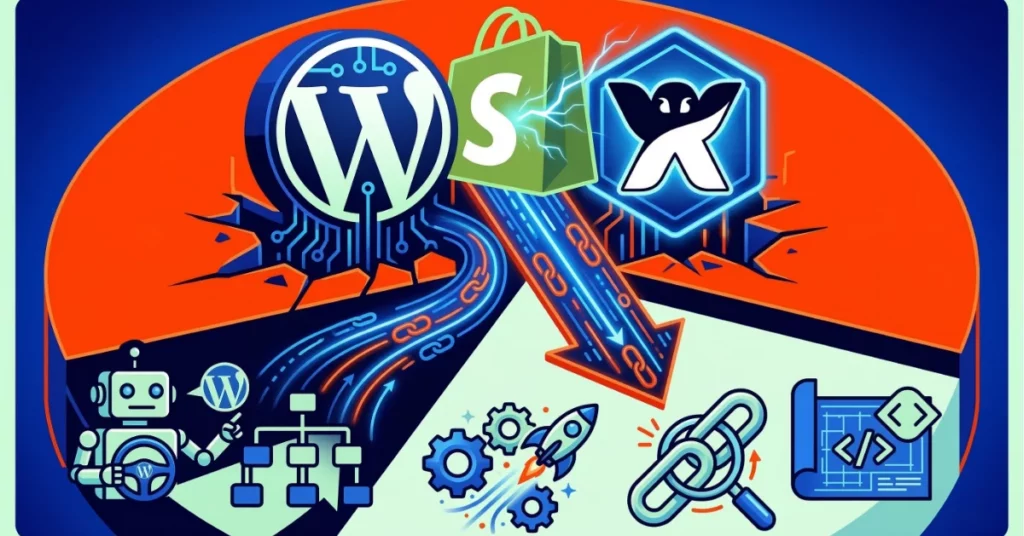
New data shows that just three content management systems-WordPress, Shopify and Wix, are controlling nearly 73% of the entire CMS market.
Their built-in settings can affect and are influencing technical SEO at a scale no individual expert can match.
This insight is taken from an analysis of 17 million websites, that is part of the latest Web Almanac research. The takeaway is simple but striking.
You will see that most SEO decisions today are no longer made manually. They are made by default.
From Fragmented Web to Platform Control
A decade ago, most have observed that the web looked very different. In 2015 when last observed, most websites did not even use a CMS for publishing. WordPress had an even modest share, with Shopify and Wix being barely visible to audiences.
That has been changing steadily. As website creation became easier, more businesses are gradually and steadily moving to managed platforms.
Today, WordPress is a leader. But gradually we see that its growth has seen a slowed pace in the present situation.
Meanwhile, Shopify and Wix have been expanding rapidly and are pulling more users into tightly controlled ecosystems.
You will also observe that, older platforms like Joomla and Drupal are no longer that important. Their combined market share has been dropping sharply.
They are been replaced by newer, user-friendly tools that require little technical knowledge.
The result is that a web that is no longer scattered and developer-driven. It is structured, templated and increasingly controlled by a handful of companies in the ecosystem.
SEO Defaults Are Doing the Heavy Lifting
What stands out in the data is where SEO actually happens now. Much of it is baked into platforms and plugins rather than handled by experts on individual sites.
For instance, the use of canonical tags and meta robots’ directives have increased across the web.
But this rise does not come from manual optimisation. It tracks closely with CMS adoption.
Plugins play a major role too. One popular SEO plugin alone accounts for a large share of optimisation settings across millions of websites.
Many of these settings like “index” and “follow” are applied automatically, even when they are not strictly necessary.
A similar pattern appears in newer trends. The adoption of files designed for AI crawlers, such as llms.txt, is growing.
But it is seen that in many cases, these files are auto-generated by plugins, and are not added deliberately by site owners.
In short, this is what looks like widespread SEO awareness is more often just automation at work.
Templates Over Precision
The influence of platforms is also visible in how websites handle structured data and images.
Homepages are usually optimised with care. But inner pages often rely on templates. This can lead to repeated or misplaced structured data, especially when platforms apply the same logic across multiple pages.
Image handling shows the same trend. While some developers actively optimise loading behaviour, most websites rely on browser or platform defaults without making any specific choices.
Even basic elements like robots.txt files are often generated automatically. They work, but they are rarely customised.
Performance Tells a Mixed Story
There is also a gap between technical setup and real-world performance.
Some managed platforms deliver strong and consistent results because they control the entire environment. Others, like WordPress, show mixed outcomes.
High-performing sites tend to invest in better hosting and careful optimisation, while many smaller sites lag behind.
This creates a wide performance range within the same platform.
Interestingly, despite lower average performance scores, WordPress still dominates among top-ranking websites.
This suggests that expert intervention still matters but mostly at the higher end.
What It Means for SEO Professionals?
The role of SEO professionals is changing. Instead of handling basic technical setup, the focus is shifting to more complex and strategic work.
Platform knowledge is becoming critical. Understanding what each CMS does by default and where it falls short can make a real difference, especially during site migrations or platform selection.
There is also growing importance in areas platforms cannot fully manage, such as AI visibility, crawl strategy and advanced optimisation.
The Road Ahead
The balance of power in SEO has clearly shifted. A few large platforms are now setting the standard for millions of websites with the help of a single update or feature change.
Individual experts are still playing a role, but mostly at the edges fine-tuning. They are also auditing and solving complex problems.
The larger influence lies elsewhere. As the data suggests, anyone looking to shape SEO at scale may need to look beyond individual websites and towards the platforms that power them.