All SEO
  SEO News
  SEO Strategy
  Ask An SEO
  Enterprise SEO
  Google Algorithm Updates
  International SEO
  Link Building
  Local SEO
  Mobile SEO
  On-Page SEO
  Technical SEO
  Vertical SEO
  Wordpress for SEO
  Web Dev for SEO
  SaaS SEO
  E-commerce SEO
  AI-Driven SEO
 Google Utilizes Infinite 301 Redirect Loops For Missing Documentation


Google utilizes infinite 301 redirects as an option to address the missing documentation pages, making it a controversial technique for web infrastructure.
Google removed the old structured data documentation a few days ago; however, they took a unique method to handle the missing pages. Instead of returning the usual error 404 “Page Not Found” error, Google has set up infinite redirect loops of 301 redirects between the original URLs, as well as a changelog page that causes crawlers to go through endless loops through the different pages.
The Redirect Loop Explained
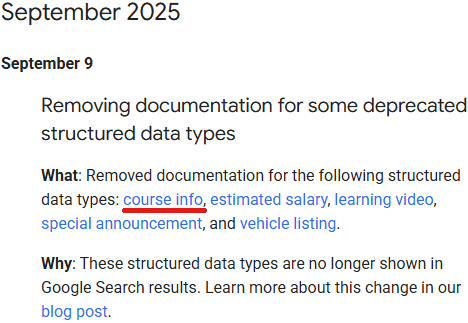
When users access certain URLs with structured data that have been deprecated, they are redirected by the 301 link to a changelog webpage, which bizarrely connects back to the missing URLs, creating an endless loop.
For instance, the “course info” structured data page was located at:
- https://developers.google.com/search/docs/appearance/structured-data/course-info
Now, however, this URL redirects to:
- https://developers.google.com/search/updates#september-2025
That still connects back to the now-defunct course information URL, trapping both crawlers and users in an unreachable circle.
Google’s Removal of Obsolete Documentation
This announcement follows an announcement in June 2025 in which Google announced that it would end support for these types of structured data:
- Course information
- Estimated salary
- Learning video
- A special announcement (returns 404, as was expected)
- Listing of vehicles
The official documentation pages for these items are now gone, likely indefinitely.
Use 301 Redirects Rather Than 404 Responses
In accordance with standard SEO practices, unreachable pages typically return an error code 404, which signals to crawlers that the URL is no longer accessible. In contrast, a 301 redirect usually directs users or crawlers to an alternative site to maintain the search engine’s value.
Google’s decision to utilize the 301 redirects that loop back to an overall update log “to a more accurate URL” involves a permanent redirection; however, this presents a problem in implementation.
It doesn’t create the appearance of a “soft 404,” but it makes user and crawler navigation a bit cumbersome, and provides an unsatisfactory user experience.
The setup is strange because Google’s changelog links to the missing page, which then redirects back to the changelog, creating an infinite loop.
Redirecting URLs to June 2025 Post
A more user-friendly and crawler-friendly solution could be to directly redirect these links to the June 2025 blog post, which explains why these structured data types are no longer supported, rather than creating an infinite loop. This will prevent loops and give a clear understanding of why pages were deleted.
Google’s configuration is unusual and contrasts with the typical SEO approach to handling outdated content. The majority of site owners prefer to utilize 404 responses and direct redirects substitutes, rather than creating complicated loops.
Although it’s unclear whether this is an intentional decision by Google or an error, it’s a significant mistake that could harm user experience and efficiency.
Bottom Line
Google’s use of endless redirect loops for 301s that lack documentation is unusual and raises doubts about its strategy for removal and redirection policies. SEOs need to keep an eye on it, as it may provide new insights into how Google manages content that is no longer in use.