All SEO
  SEO News
  SEO Strategy
  Ask An SEO
  Enterprise SEO
  Google Algorithm Updates
  International SEO
  Link Building
  Local SEO
  Mobile SEO
  On-Page SEO
  Technical SEO
  Vertical SEO
  Wordpress for SEO
  Web Dev for SEO
  SaaS SEO
  E-commerce SEO
  AI-Driven SEO
 Google Says AI Previews Have Not Impacted Overall Referral Traffic From Search

Google has responded to reports that its AI-driven summaries in search results are drastically reducing the amount of traffic referred.
The company takes issue with these concerns in a blog post today, in which Google has responded by writing that the scale described is “overstated” and claiming it accounts for only a small percentage of overall click volume from Google Search.
Google, naturally will say this, but according to their official blog post there is no evidence to support these claims.
According to Google:
“Overall, total organic click volume from Google Search to websites has been relatively stable year-over-year. Additionally, average click quality has increased and we’re actually sending slightly more quality clicks to websites than a year ago (by quality clicks, we mean those where users don’t quickly click back — typically a signal that a user is interested in the website). This data is in contrast to third-party reports that inaccurately suggest dramatic declines in aggregate traffic — often based on flawed methodologies, isolated examples, or traffic changes that occurred prior to the roll out of AI features in Search.”
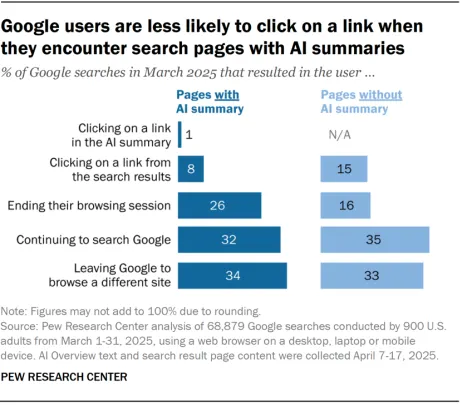
While the data is compelling, Google is specifically challenging one of these reports, which is a recent Pew Research study that analyzed the search history of more than 900 users.
In fact, as the figure below shows, when Pew asked users who saw an AI-generated summary to access more information on what they had just read, only 8% of them ended up clicking through to a traditional search result; those without a summary did so for about 15%.
Google’s Perspective on AI Overviews
This is a significant finding, indicating a major change in the way people search. The research has often been reported as proof of Google’s AI-driven change. However, Google has specifically called this one out, arguing that it is too small a sample (just 900 users) is not enough to be reliable.
It is true that 900 people are only a part of millions of Google’s daily users. However, as a first indicator, this data could have that there is some influence on traffic to the web. Isn’t it?
But Google insists on saying no and added:
“With AI Overviews, people are searching more and asking new questions that are often longer and more complex. In addition, with AI Overviews people are seeing more links on the page than before. More queries and more links mean more opportunities for websites to surface and get clicked.”
Impact on Specific Content Types
Google claims it is true that AI previews do increase the number of referrals, but they acknowledge some minor impact by pointing out:
“For some questions where people are looking for a quick answer, like ‘when is the next full moon,’ people may be satisfied with the initial response and not click further. This has also been true for other answer features we’ve added, like the Knowledge Graph or sports scores. But for many other types of questions, people continue to click through, as they want to dig deeper into a topic, explore further or make a purchase.”
Google also claims that even though certain websites are experiencing declines, other sites, such as forums or podcasts, video platforms and sites that feature articles are gaining more visitors than they did before.
“People are also more likely to click into web content that helps them learn more — such as an in-depth review, an original post, a unique perspective or a thoughtful first-person analysis. Sites that meet these evolving user needs are benefiting from this shift and are generally seeing an increase in traffic.”
The Reddit site is clearly gaining more traffic. You have likely seen more Reddit links appearing on search pages.
This shift could be a clue to what kind of content performs best in the era of AI previews, as well as the evolution of patterns of searching. However, here’s the problem: Google hasn’t actually shared any data that can prove its assertions.
Instead, Google’s message generally is not to worry as you are in good hands. Certain sites may lose traffic while others are increasing, so everything is in balance! The internet is now better than ever before. Don’t overreact.
But… ‘No‘.
The reality is that lots of websites have been losing visitors and for many companies, it’s an extremely serious issue.
The Bigger Picture: Data Support
While Google has been misguided about their reassurances, several reports suggest that many websites are losing traffic, specifically those relying too much on organic search. The Wall Street Journal, for instance, reported back in June that search traffic to prominent news sites from organic search has fallen sharply for every major news organization.
According to Wall Street Journal analysis of Similarweb data, HuffPost’s organic search traffic has dropped by more than 50% over the last three years, that mirrors similar patterns of decline in The Washington Post and Business Insider.
“Business Insider’s traffic from Google searches alone dropped 55% between April 2022 and April 2025, based on data from Similarweb.”
The decline in traffic was a factor in Business Insider’s staff reduction of 21% in June The company’s management specifically noting “extreme traffic drops” as an important factor.
Although some may view this as an opportunity – particularly when the outlet is experimenting using AI-generated content, the overall trend is clear. Every single publisher that relies upon Google Ads revenue is facing the same looming threat.
Other Data Reports
Data from other reports suggest similar patterns:
- The Current reported that traffic to the top 500 publishers fell by 27% YoY.
- Digiday reported the share of U.S. news searches that did not lead to new site clickthroughs increased from 56% to almost 69% after Google debuted the AI profiles.
- Authoritas said sites currently ranking number one in search could lose an estimated 79% of traffic on SERP if their results were pushed below an AI summary.
However, SimilarWeb, a leader in web analytics, reports an increase of 357% for referrals driven by AI since June 2024. This data is consistent with Google’s assertion that we are seeing an important shift in distribution of traffic from search engines, not its complete disappearance. The dominance of the top search engine results may eventually be breaking down
Future of AI and Search
Google believes that AI Overviews are a net positive for the search ecosystem, despite the controversy. Those changes are said to enhance the search experience for everyone by tailoring content to suit individual users. Google contends that the wider web will benefit, however, there may indeed be short-term pain felt by some sites, especially news publishers.
Only 20% of desktop searches currently display AI overviews, leaving many questions about how their development will impact the web. If adopted more widely, this change could reshape referral patterns substantially.
Google concluded that it “cares passionately about the web ecosystem,” and that they are also very mindful of these impacts.
Google will likely inform website owners that the new search results may not significantly impact traffic. However, businesses relying on Google search should still pay attention to the changing SEO tides.