All SEO
  SEO News
  SEO Strategy
  Ask An SEO
  Enterprise SEO
  Google Algorithm Updates
  International SEO
  Link Building
  Local SEO
  Mobile SEO
  On-Page SEO
  Technical SEO
  Vertical SEO
  Wordpress for SEO
  Web Dev for SEO
  SaaS SEO
  E-commerce SEO
  AI-Driven SEO
 Google AI Overview Citations from Top-Ranking Pages Drop Sharply

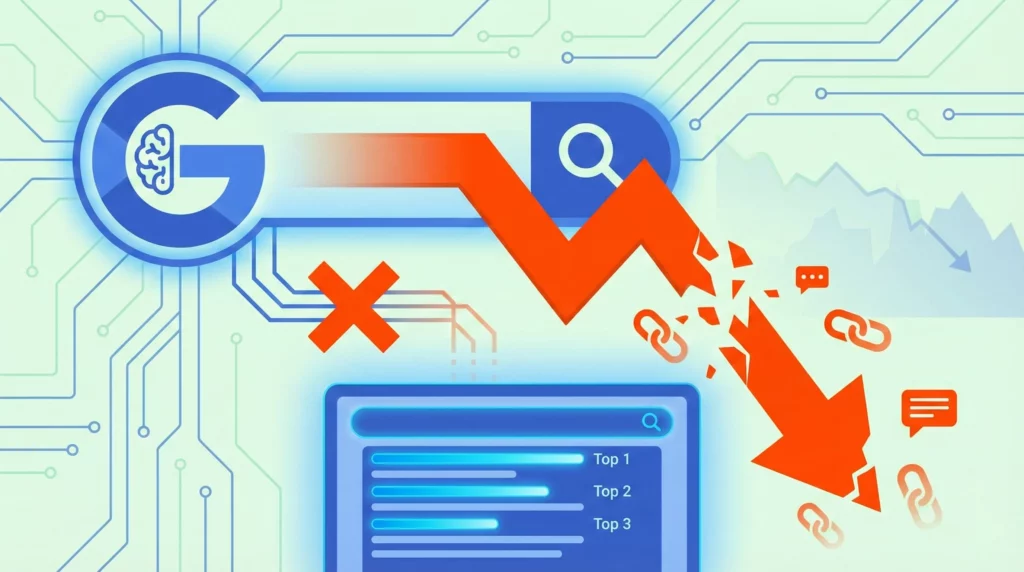
New research shows that ranking on page one of Google is no longer a strong signal that your page will be cited in an AI Overview.
An updated study by SEO tool provider Ahrefs went on to analyze 863,000 keywords with 4 million AI Overview URLs. The findings went on to suggest a major shift in how Google selects sources for its AI-generated summaries.
Top 10 Rankings No Longer Dominate Citations
Ahrefs found that only 38% of pages cited in AI Overviews also ranked in Google’s top 10 results for the same query.
That is a sharp drop from its July 2025 study, which showed 76% overlap between top-10 rankings and AI Overview citations.
The remaining citations were spread widely:
- 31.2% came from pages ranking between positions 11 and 100
- 31.0% came from pages ranking beyond position 100
Put concisely, nearly two-thirds of cited pages were not able to appear on page one.
Two Ways of Measuring- It is the Same Pattern
Ahrefs ran two versions of its analysis.
The first included all types of search results. That meant ads, featured snippets, People Also Ask boxes, and video packs were counted.
The second version looked only at standard organic listings.
The results were close. In the organic-only test:
- 37% of cited pages ranked in the top 10
- 36% ranked beyond position 100
The slightly higher share of pages outside the top 100 suggests that some AI Overview citations may come from pages that appear in special search features, not in traditional blue-link results.
Why The Drop Happened
Ahrefs points to two main reasons.
First, the company improved its citation detection since last year. It can now identify more sources inside AI Overviews. That means some of the drop may be due to better tracking, not only a change in Google’s behavior.
Second, Ahrefs highlights Google’s “fan-out” query process.
When a user triggers an AI Overview, Google may break the original query into several related sub-queries. It then gathers results for each sub-topic. Pages that appear frequently across those sub-results are more likely to be cited.
This means a page does not need to rank for the exact keyword to be included. It may rank well for a related sub-query instead.
Google has not confirmed changes to its fan-out process. However, AI Overviews were upgraded globally to Gemini 3 in January, which may have influenced how sources are selected.
A separate study by BrightEdge, published on February 12, found only 17% overlap between top-10 rankings and AI Overview citations. Although the methodology was different, the trend points in the same direction.
YouTube’s Growing Role
One of the clearest patterns involves YouTube.
Among AI Overview citations that did not rank in the top 100 for the same keyword, 18.2% were YouTube URLs. Overall, YouTube made up 5.6% of all AI Overview citations in the dataset.
Ahrefs also reported that YouTube is now the most-cited domain in AI Overviews. Citations to YouTube have grown 34% over the past six months, based on Ahrefs’ Brand Radar data.
Other studies support this trend. Research by SE Ranking found YouTube was the most-cited domain in German health-related AI Overviews, even ahead of official medical websites.
Earlier Ahrefs research also showed YouTube leading citations in AI Overviews, while Google’s AI Mode leaned more on Wikipedia and Quora.
The pattern is clear. Video content is playing a larger role in AI-generated answers, even when videos do not rank prominently in standard results.
Why This Matters For SEO
The link between organic rankings and AI citations is no longer stable.
In late 2024, one study showed that 75% of AI Overview citations came from top-12 pages. BrightEdge reported 54% overlap in October 2025. Now some new studies are placing the figure between 17% and 38%.
This is a dramatic shift seen in less than two years.
Ranking for a single keyword is now not that enough. Google’s AI can evaluate content across related questions and subtopics. Depth and coverage matter more.
Multiple formats, including video, may also improve visibility in AI summaries.
What Comes Next
If fan-out queries continue to guide source selection, the gap between organic rankings and AI Overview citations may widen further.
For publishers and brands, this means rethinking strategy. Visibility inside AI Overviews may depend less on holding a page-one spot and more on covering a topic broadly, clearly, and in different formats.
The rules are changing fast. And page-one rankings are no longer the full story.