All SEO
  SEO News
  SEO Strategy
  Ask An SEO
  Enterprise SEO
  Google Algorithm Updates
  International SEO
  Link Building
  Local SEO
  Mobile SEO
  On-Page SEO
  Technical SEO
  Vertical SEO
  Wordpress for SEO
  Web Dev for SEO
  SaaS SEO
  E-commerce SEO
  AI-Driven SEO
 The Unseen Engine: How Digital Agencies Are Quietly Powering America’s GDP


The $350 Billion Question
When economists measure GDP, they think about cars rolling off assembly lines, houses being built, and consumers swiping credit cards.
But here’s the thing: some of the fastest-growing parts of the U.S. economy don’t show up cleanly in the data. We are talking about digital marketing agencies.
The firms running TikTok influencer campaigns. The teams behind your Google Ads. The consultants are optimizing “dark social” buzz.
From SEO and programmatic advertising to TikTok influencers and lead-generation funnels, these agencies orchestrate billions in transactions. Yet, due to gaps in tracking, attribution, fraud, and reporting, a significant portion of their value creation doesn’t fully register in GDP.
Together, they represent a $350 billion+ ecosystem. And much of their contribution is hidden in plain sight.
This is the story of how agencies became the unseen engine of America’s GDP and why economists are only now catching up.
Enter digital marketing agencies, they are the hidden gears that keep America’s consumerism engine running. These agencies handle billions of dollars in transactions, from search engine optimization and programmatic advertising to TikTok influencers and lead-generation.
Yet, because of gaps in tracking, attribution, fraud, and reporting, a significant chunk of their value creation doesn’t fully register in GDP
Think of them as an unseen engine humming behind the dashboard of the U.S. economy. We feel the pull (higher sales, viral brands, new consumption patterns), but when we check the official gauges, the power isn’t fully reflected.
This piece explores how digital agencies quietly fuel America’s economy, why much of their impact goes untracked, and what’s being done to finally count them.
Along the way, we’ll highlight real data, recent regulations, and charts that make the hidden economy visible.
A handful of big social networks hide their referral traffic, and a big group of others hide their referral data at least some of the time.
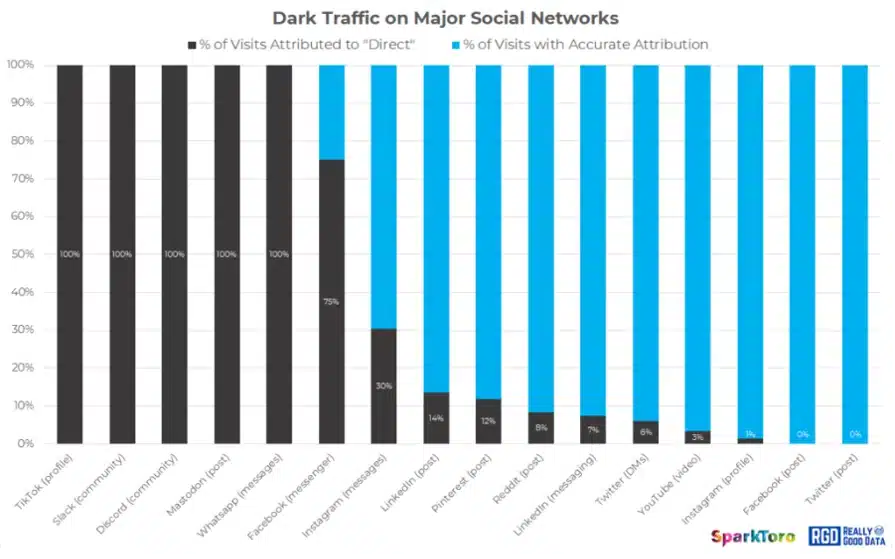
The above chart shows that-
- All visits from TikTok, Slack, Discord, Mastodon, and WhatsApp were listed as “direct” and didn’t have any further referral information.
- Instagram direct messages, also known as DMs, as well as public posts on LinkedIn and Pinterest, also missed a lot of referral data (30%, 14%, and 12%, respectively).
- 75% of visits from Facebook Messenger don’t have any referral information. It doesn’t seem like this is only about the sort of browser, device, or web vs. app.
- Reddit posts, LinkedIn messages, and Twitter DMs all wrongly attributed a reduced percentage of traffic to “direct.”
- For now, YouTube, public Instagram profile links, public Facebook posts, and Tweets seem
- to give referral data in most or all cases.
Finally, website owners and marketers should assume that a lot of the traffic that their analytics calls “direct” came via these networks.
Dark Social is a real thing that is still happening, and it can cause problems for people who believe what their analytics say about channels and sources.
How GDP Traditionally Captures (and Misses) Value
GDP in its simplest formula is,
GDP = C (Consumption) + I (Investment) + G (Government Spending) + (X-M)
(Exports-Imports)
Now, considering the marketing activities, they usually fall under the intermediate consumption (costs that businesses incur on their way to make final sales).
Let’s say if a company like Nike pays an agency to design a TikTok campaign that doesn’t show up as a main item in GDP, then such a campaign is absorbed into the cost of shoes sold to consumers.
Such a campaign tends to create two types of distortions-
1- The value of agency gets hidden as they orchestrate demand, yet their contribution is collapsed into either “shoe sales” or “e-commerce.”
2- All the waste gets counted if a third of the spend disappears into fraudulent clicks or MFA (Made-For-Advertising) sites, but GDP still counts it as activity when even the real value is not created.
The Bureau of Economic Analysis (BEA) understood the concern and tried to fix this with the Digital Economy Satellite Account (DESA), which brought in front the digital economy’s share of GDP.
But budget cuts ended that effort in 2025. Without it, what was left was just fuzzy numbers and a blind spot around agency-driven commerce.
The Problem: Measurement gaps create a hidden agency’s economy
Dark social
A big chunk of social-originated visits is mislabelled as “direct” because links are shared inside private channels like WhatsApp, iMessage, DMs, and email that strip most of the referral information.
Research conducted on understanding direct traffic found dark social misattribution is significant enough to distort channel ROI.
It indicates that agencies generating lift in these channels are not getting credited, and the resulting commerce is under-attributed in firm accounts.
Programmatic opacity
Open-web programmatic buying has improved, but still leaks value. The ANA found sharp drops in spend to MFA sites from 2023 to 2024 (median down from ~10% to ~1.1%), yet wasted ad spend remains a multi-billion-dollar drag.
A previous important study (ISBA/PwC) found a “unknown delta” of about 15% of spending that couldn’t be tracked across the supply chain.
Later, upgrades made the match rates better, but they also showed that the structural opacity problem still existed.
According to parallel estimates, ad fraud and invalid traffic steal tens of billions of dollars per year around the world. The exact amounts vary by technique, but the trend is evident.
It matters because when money goes to unclear paths or bots, the “gross” media spending figure is too high for real economic production and too low for true agency value creation (strategy, creative, data engineering) that truly drives sales.
Gray areas of lead generation
Performance agencies frequently make money by sending leads and calls to businesses. In the past, “lead generator” sites could get permission from users and then sell that information to several callers.
The FCC’s 2024 decision closed this loophole. Starting on January 27, 2025, each seller’s calls and texts must be consented to one-on-one, changing the economics of compliant lead generation.
Impact: Stricter permission regulations push activities into more trackable, contract-bound channels, but they also reveal old ways of doing things where money may have been made without good records.
Influencer and review manipulation
The FTC’s new Endorsement Guides (2023) and its final rule in 2024 that bans fake reviews and testimonials allow civil penalties for misleading reviews and undisclosed paid posts.
These rules are aimed at parts of the creator/agency economy that made money with bad paper trails or “in-kind” payments.
Ultimately, more compliance results in more transactions “on the books,” but enforcement also reveals the extent to which business has been impacted by strategies that aren’t always clear and easy to measure.
The Scale of Digital Agencies in the U.S.- Facts, Data & Law
Often under-documented creator channels
To understand the size of the “unseen engine,” consider the following facts-
- More than 70% of marketing budgets now flow through digital channels.
- U.S. digital ad spending in 2024 exceeded $350 billion, according to eMarketer.
- Agencies in America are actively providing everything from SEO and PPC to influence campaigns, programmatic media, affiliate management, and lead generation.
Not only is this ecosystem vast, but it ranges from Madison Avenue giants like Omnicom and WPP to boutique performance agencies in Phoenix, freelancers in Austin, and creator-driven micro-agencies in Atlanta.
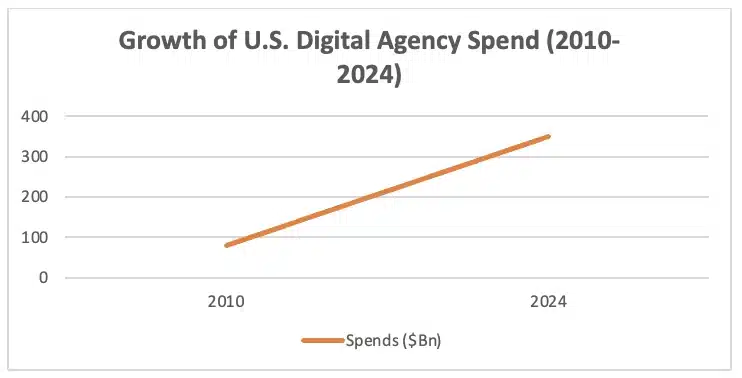
What is striking from the chart is that even with this massive spend, much of the impact slips under the radar because of high digital work.
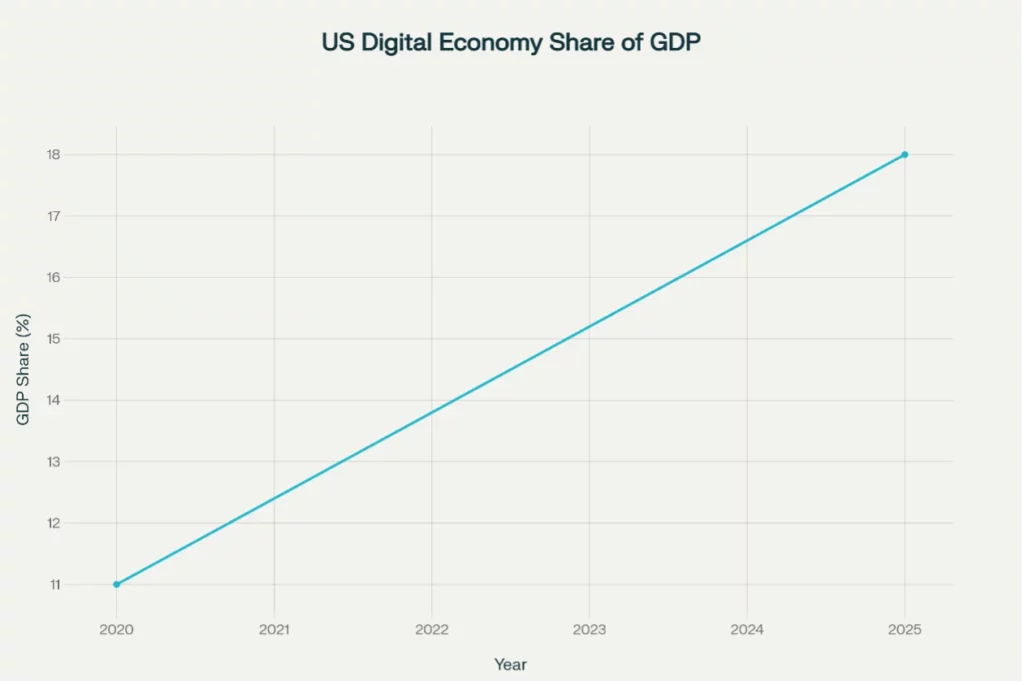
Additionally, the digital sector grows 12 times faster than the broader job market. The image below shows that the Digital Economy has more than doubled since 2020, and now hits $4.9 trillion, contributing 18% of U.S. GDP and supporting 28.4 million jobs in 2025, nearly a tenfold increase.
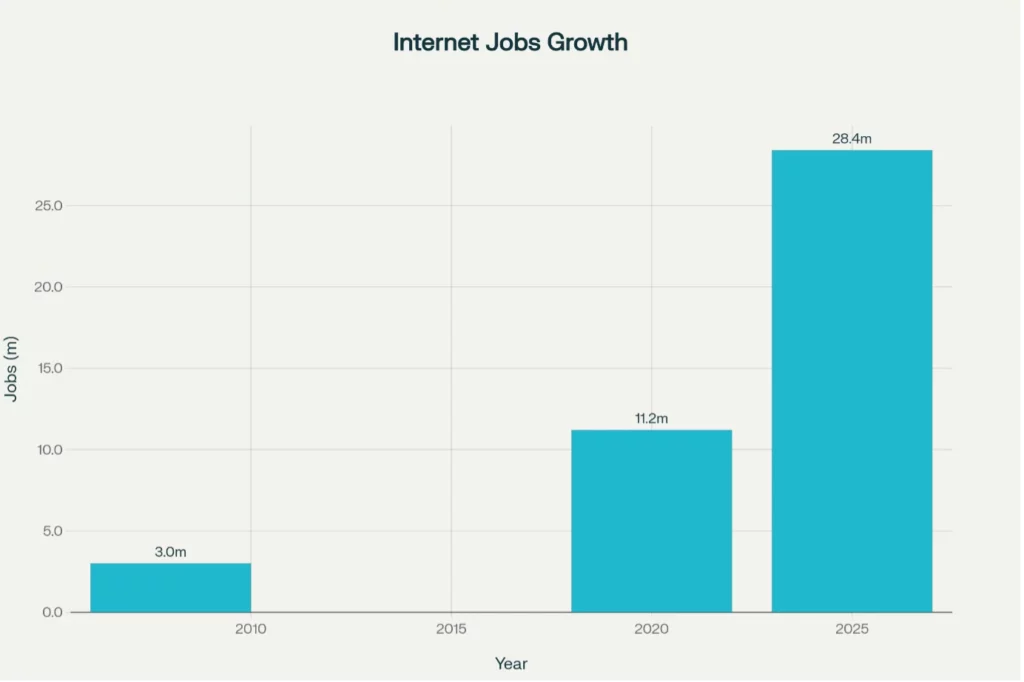
A report on measuring the digital economy by IAB shows job market transformation, digital creators and social influencers making up to 1.5 million full-time US jobs in 2025, multiplying nearly eightfold since 2020.
70% of digital job growth stems from independent creators, platform workers (Uber, DoorDash), online merchants, and integrated tech firms.
Let’s look at the shifts in Digital Agency Services (2023-2025)-
- A digital agency industry report by Promethean Research shows that traditional web development and design are declining. Web development is down from 75% to 69% of agencies, and design from 73% & to 67%.
- It shows a rise in AI services from 10% to 17%, SEO, content marketing, and direct response challenge.
- A declining demand for mobile applications and UX/UI services (mobile development design dropped from 27-29% in 2023 to just 12-14% in 2025).
- Email and social media marketing rose by 5% and points 2023-2024, remaining steady in 2025
Among big techs and macroeconomic drivers, Business Insider shows that AI and digital investments are propping up GDP growth; without their impact, US GDP growth in 2025 would be less than 1%. Major tech firms like Amazon, Microsoft, Google, and Apple are doubling capital investments in digital infrastructure and AI.
Moreover, digital agencies’ adoption of generative AI is enabling 1.5-3% annual gains in productivity, with structural economic impacts predicted to last decades.
IRS tax gap & platform reporting rules
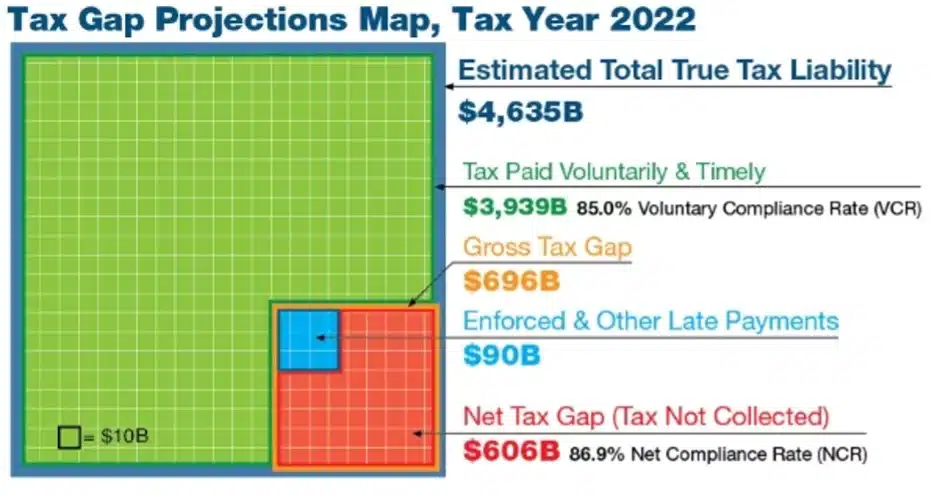
The IRS thinks that the gross tax shortfall for TY 2022 will be about $696 billion, with net around ~$606 billion after late payments and enforcement, with underreporting being the biggest part.
Agencies, creators, and small digital sellers usually file as sole proprietors (Schedule C), which is a category that has been linked to under-reporting hazards in the past.
The requirements for Form 1099-K are being put into place slowly. For 2024, the national threshold is $5000, and it will go down after that.
It is important to mention that the IRS says $2,500 in 2025 and $600 in 2026, which would bring more payments made through platforms into the tax net, making such apps change their instructions to match.
It can be inferred that some agency/creator flows that used to be below reporting criteria or were wrongly labelled as personal are now reportable, meaning that revenues that were hidden before are now visible.
Programmatic waste & exposure to MFA
ANA’s first look from 2023 shows MFA sites made up 15% of ad spending and 21% of impressions in the study group.
Work done after that in 2024 shows progress, although there is still waste. Different methods are used to predict worldwide ad-fraud losses, which range from about $84 billion in 2023 to more than $100 billion in 2024. Click-fraud sub-estimates are all over the place, but they all lead in the same direction.
Agencies are having trouble with a supply chain where some of the spend isn’t really creating value, which makes firm-level ROAS and macro measurements of production look bad.
Lead-gen law & data broker enforcement
As per the FCC, one-to-one consent for lead generation under the TCPA framework and the Delete Act in California mandates data brokers to register and disclose, and there are current enforcement sweeps and a 2025 punishment that show how compliance risk is growing for data flows that many lead-gen ecosystems depend on.
Such restrictions force traffic and lead marketplaces that used to be a secret to register and keep records, or they go out of business.
GDP accounting realities
The Bureau of Economic Analysis (BEA) sees ad-supported “free” media as intermediary consumption for the advertiser, not final consumption for households.
That stops some digital value from showing up as final production, even though it obviously affects consumer surplus and sales. One reason the Digital Economy Satellite Account existed was to better map digital contributions.
The shadow or underground economy, which is legal but not recorded, is not included in GDP. Credible estimates say that the U.S. shadow economy makes up about 6-8% of GDP, which is a small amount.
In short, even when agencies create real demand and sales, the accounting system and lack of compliance can make their worth and national output look lower than they really are.
The Current Situation (2024-2025 Snapshot)
Attribution has gotten worse as private sharing and ad-tech signal loss (cookie depreciation, iOS ATT) are pushing more discovery into channels that aren’t being tracked.
Agencies know how to use podcasts, hidden social networks, and collaborations with creators get a lot more business than dashboards show as “direct.”
The growth in the digital sector outpaces the rest of the economy, which overall GDP slowed to 1.5% annual growth in 2025; the digital sector is expanding at a 19% yearly rate.
The hidden agency economy is peaking because several forces collide at once:
- Signal loss: Third-party cookies dying, Apple’s ATT, and GDPR. Agencies can’t see conversions easily.
- Dark funnel: Podcasts, private communities, Slack groups drive sales unseen by dashboards.
- Compliance squeeze: FTC bans fake reviews (2024), FCC reforms lead-gen (2025), California CPPA enforces data-broker rules.
- IRS crackdown: More payouts get reported, shrinking the grey zone.
- Advertiser pushback: Brands demand transparency, cutting MFA waste.
It’s a perfect storm of exposure — both revealing how big agencies are, and how undercounted they’ve been.
Compliance squeeze
The FTC’s 2024 Consumer Reviews & Testimonials Rule punishes fraudulent or sponsored reviews that aren’t disclosed. This makes grey-area methods more expensive and spends money on better-tracked workflows.
The FCC’s change in lead-generation consent requires one-to-one consent and proof that can be checked, which changes the unit economics of call-centre and form-fill arbitrage.
State privacy and data broker laws, like the California Consumer Privacy Act (CCPA), make it harder for data brokers and their partners to register, share information, and delete data.
This makes it easier to see where traffic comes from and how revenue is distributed.
Payment transparency ramp
The IRS’s progressive implementation of the 1099-K is bringing creator/affiliate/agency flows
into the reportable economy, making the grey slice of income smaller every year.
As of 2025, 84% of agencies identify as specialists instead of generalists. Agencies that expand
services of rethink positioning grow 8-10 times faster than those that do not.
Programmatic accountability
New ANA benchmarking and advertising scrutiny on MFA placements are making things run more smoothly, but they are also measuring waste that used to be seen as the cost of doing business.
Nearly 28% of agencies raised prices entering 2025, but heightened competition means differentiation and proven ROI are more important than ever.
In summary, the 2024-2025 snapshot reveals that the digital agencies are quietly driving US GDP and jobs, adapting quickly to technological and economic change, and enabling inclusive growth far beyond coastal tech centers.
Their unseen contributions make them America’s indispensable economic engine.
How the hidden agencies’ economy fuels “uncounted” GDP
The hidden agencies do so by driving a range of informal, underreported, and offshore activities that never fully make it into national statistics, yet play a vital role in economic growth and resilience.
Mechanism 1: Under-the-radar transactions
Many digital agencies, especially those working as freelancers, in small partnerships, or
handling offshore outsourcing, operate outside formal registration, tax, and reporting
frameworks.
Payments may go underreported, contracts may be kept informal, and revenue
risks may be missed by official GDP calculations.
If $1 of sales comes in with the label “direct,” the agency’s contribution (and often the creator’s) is not shown in firm-level marketing mix models.
This means that clients don’t book agency value correctly and occasionally move spending off-invoice (for example, in-kind creator deals), which keeps some transactions informal.
At a large scale, this lowers the measured value added by agency services.
Mechanism 2: Opaque ad spending is counted as a cost, not an output
Media spending that is fake or based on MFA makes “gross” nominal flows look bigger, but it
doesn’t create genuine final demand. MFA sites saw a sharp decline in ad spend allocation from
15% in 2023 to just 6.2% in 2024.
At the same time, real demand creation (strategy, creative,
and analytics) is often under-billed or paid for in ways that don’t fit GAAP revenue.
In short, official data makes low-value media look more valuable than it is and high-value
agency services look less valuable than they are.
US agencies increasingly contract work to individuals and companies offshore, like India, and
other emerging markets, often with minimal regulatory oversight.
The cross-border payments
and project-based income enable significant economic activity that remains outside US GD
accounting and local tax records.
Mechanism 3: Tax avoidance and evasion
Some agencies and their contractors actively avoid reporting digital revenues to benefit from tax
savings, intentionally lowering the visibility of significant value creation within digital markets.
They either do not report their taxes or report them late. Before the 1099-K phase-in, small
creators and affiliates could not report or channel payments across platforms and beneficiaries.
Under-reporting puts money into the tax gap, which lowers the recorded national income and,
as a result, the measured GDP on the income side.
Mechanism 4: National accounts conventions
According to The Inclusive Growth and Development Report 2017, the rise of remote, project-based work (content creation, SEO, design, micro coding tasks) via global digital platforms means countless transactions are conducted off the books or outside established payroll systems.
Some digital intangibles and “free” services that are paid for by ads are considered intermediate. The BEA’s digital satellite account (last updated in December 2023) tried to show the whole footprint, but it is no longer doing so.
That means that some digitally mediated welfare and productivity are not included in the headline GDP.
Then, what is the overall impact on scale?
Overall, the impact hits directly on many advanced economic costs. The shadow or hidden
economy accounts for an estimated 10-40% of GDO, though it is exceedingly difficult to
precisely measure.
For the US, unreported digital agency work, offshore outsourcing, and gig transactions account
for billions of dollars in annual value, supporting job creation, innovation, and consumer
spending, but remaining uncounted in official GDP output.
Why does this matter?
It matters because of the hidden agencies filling gaps that are left by the formal economy, fuelling entrepreneurial growth in America.
It fuels the rapid adaptation and income for marginalized groups during downturns. Moreover, governments miss out on billions in tax collection, which could fund public programs and services.
In short, the unseen, uncounted GPD powered by hidden agency economies represents a substantial portion of real economic activity.
The actual impact of digital agencies in driving growth, exports, and jobs is much greater than what appears in official statistics.
How Indian Digital Marketing Agencies Fit into the “Unseen Engine”
More and more big US firms and government organizations are taking advantage of Indian digital marketing agencies by hiring them to do work for much less money.
This helps them make more money while also using India’s experienced workers and advanced technology.
Bulk Outsourcing Models
US companies and agencies commonly hire Indian organizations to handle large projects like SEO, content, PPC, and campaign management. This is a lot cheaper than recruiting people in the US or UK
Let’s say a US strategist might charge $150/hr. On the other hand, an Indian equivalent is often
billed at $20-30/hr.
Another reason for outsourcing large projects is the time zone difference,
which allows work to be done overnight for US clients.
Result being the Indian agencies become the back-office horsepower of global campaigns.
But while the value created might be millions in U.S. sales, the fees captured by Indian agencies
are a fraction.
Invisible in US GDP: Invisible in Indian GDP
The irony being, in the US, outsourcing lowers visible agency costs, but the sales still boost US
GDP.
Contrary to this, in India, the outsourced work is billed cheaply, often through service contracts,
which don’t capture the true downstream value.
A research study using the currency demand/monetary approach shows a large fluctuation in the shadow/unreported economy in India over the past decades, sometimes rising above 40%, sometimes lower.
This shows that a large share of economic activity in India is not captured in formal GDP. So,
Indian agencies contribute to America’s economic growth, but in both countries, their actual
impact gets undervalued.
Race to Bottom Pricing
U.S. agencies pay Indian digital marketers $15 to $40 an hour, while U.S. agencies pay $100 to $150 an hour.
In India, monthly SEO packages cost between $700 and $1,400, while in the US, they cost between $1,200 and $2,000. General digital marketing initiatives in India might be 50% to 70% less expensive than similar work in the US.
Full PPC campaign setups at $300-500 vs. $3000-5000 in the U.S., and social media management at $150/month vs. $1000 in the U.S.
This low-cost positioning locks Indian agencies into volume-based, low-margin work, while U.S./European agencies bill premium retainers for strategy and client management layered on top of the same execution.
Let’s look at the SEO outsourcing pros & cons for India vs. the USA
| Factor | India | USA |
| Cost | Very low cost ($20–30/hr on averageAffordable monthly retainers ($300–$1,000 for small businesses)Often underpriced; “race to the bottom” on platforms | High cost ($100–$150/hr)Retainers often $3,000–$10,000+ per monthHigher margins sustain quality staff & tools |
| Talent Pool | Huge pool of SEO professionals and IT-trained graduatesSpecialized execution teams (link building, content, audits)Often focused on execution, not strategy | More exposure to brand strategy and global marketsStrong client communication & consulting skillsSmaller workforce compared to India |
| Quality & Standards | Good at large-scale execution (content, backlinks)Many agencies ISO / Google-certifiedQuality varies widely; need vetting | Consistent quality standardsBetter alignment with Western marketsExpensive; may not handle high-volume repetitive tasks |
| Communication | Time zone differences can slow collaborationSometimes weaker client-facing skillMany firms now have English-proficient teams | Easier communication with U.S./Western clientsSame time zone = faster collaborationLess flexibility for round-the-clock execution |
| Innovation & Strategy | Agencies often boxed into execution workLess direct exposure to brand strategy decisionsSome top-tier Indian agencies are catching up fast | Strong in strategic planning, positioning, and analyticsBetter for high-level consultingOutsource execution anyway (sometimes to India!) |
| Scalability | Easy to scale execution quickly due to large teamsCost-efficient for bulk SEO campaigns | Expensive to scaleBetter suited for niche/high-value consulting |
| GDP & Value Capture | Contribution undervalued; booked as low-cost service exportsInvisible in final client reports & GDP stats | Value fully captured in U.S. GDP (as final sales uplift)Agencies command higher margins & recognition |
SEO Outsourcing India vs. USA Source: Author
Taking Advantage of India’s Skilled Workforce
Every year, India generates thousands of certified digital marketers who are experts in international platforms and speak English fluently. This means that global standards can be met at a lower cost.
Indian agencies often offer package pricing and bulk deals, which let them offer more services without raising their prices.
The US has a lot of talented people to choose from, which helps agencies grow quickly, but the pay disparity is big.
This tends to US businesses to save 30-70% or more on operations, but they rarely use this extra money to raise partner rates to build long-term capacity in India.
The Biggest Exploitation Narrative
Payments based on KPIs or deliverables might lower effective pay even more, since Indian
agencies do more work for less money than Western agencies do.
Indian agencies aren’t just underpaid; they are structurally undervalued in the global economy.
Also, the same piece of work is discounted in both countries’ GDP calculations.
Additionally, Indian digital marketing agencies have become the invisible workhorses of the
global advertising economy, delivering SEO, content, and campaign execution at a fraction of
Western costs.
The cost arbitrage allows American and European agencies to white-label Indian output,
capture the premium margins, and present the results as their own. The outcome is a structural
imbalance!
Indian teams are stuck doing low-margin work, while Western agencies control strategic credit and GDP recognition.
Indian agencies help the world grow, but they don’t show up in either the US or Indian GDP. Instead, they are seen as “cheap inputs” rather than co-creators of economic value.
Amongst all, curious provocation remains. If Indian agencies were paid US-equivalent rates for
their work, then-
- US marketing costs would skyrocket, forcing brands to rethink campaigns.
- India’s GDP contribution from the digital economy could jump significantly, repositioning India
as a co-creator of global value rather than just a cheap outsourcing hub.
Breaking the Cycle: Solutions to end exploitation of Indian digital agencies
To reverse the exploitation and imbalance facing Indian digital marketing agencies and help capture their true economic impact, a mix of policy changes, industry standards, and collaborative practices is needed.
For Governments and Regulators
- Indian and other outsourcing hubs should set minimum wage and fair pay standards for digital export work to stop contracts that go to the lowest bidder.
- Make it easier to declare digital exploration income so that freelance and fractional agency employment is better reflected in the national GDP. For openness, encourage direct payments and audits.
- Public money for advanced certifications (AI, analytics, creative tech) gives Indian workers the power to ask for greater pay and move up the value chain.
For US Businesses and Agencies
- Set ethical standards and only work with recognized agencies that are dedicated to fair pay, professional growth, and skill development for their teams.
- Don’t just have Indian teams do the work; have them help with campaign strategy and creative ideas. This will shatter the low-margin, labour-intensive model and build long-term partnerships.
- Instead of one-time deals, offer contracts and retainers, and make sure there are obvious ways for partners to improve their skills and grow only compete oin their careers.
For Indian Agencies and Talent
Don’t only compete on price; instead, set yourself apart with unique abilities and develop powerful agency brands. Concentrate on export achievements, distinctive skills, and a clear return on investment.
Get certified by Google, HubSpot, and SEMrush, and put money into new technologies to charge more and offer better solutions.
Join or start a professional group to create industry-wide standards and negotiate with big global partners to get better deals.
For People and Businesses in the Industry
Freelance and outsourcing sites should show wage ranges, let users rate agencies, and push for contracts that follow international standards.
Independent audits and reports build trust, show the best ways to do things, and help businesses find ethical partners who will pay fair salaries.
Overall, to get rid of the curse of low-cost exploitation, we need to take action on many levels,
including changing the government, changing the way agencies work, and changing the way
businesses do business.
This will make sure that Indian digital marketing agencies are paid fairly, work openly, and
become strategic creative partners in the global digital economy.
Practical Roadmap to Make Your Revenue and Impact Fully Count
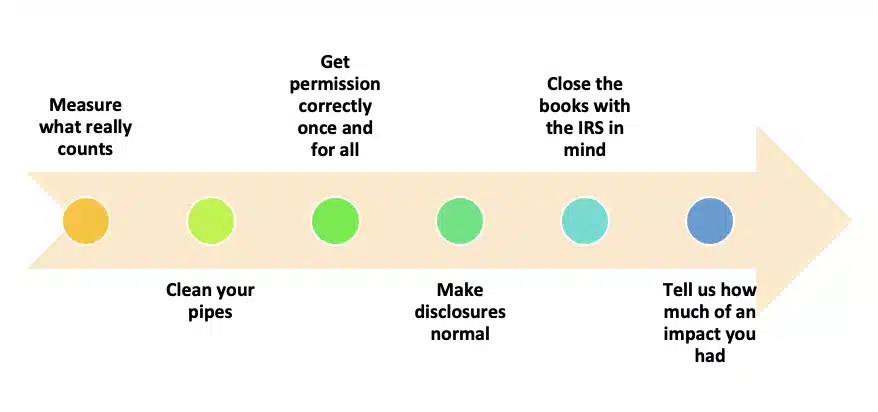
Step 1: Measure what really counts (not just the latest click)
- Use MMM and geo-experiments from survey-based and log-based research to calibrate your analytics.
Step 2: Clean your pipes
- Every three months, check your programmatic stack against ANA benchmarks.
- Limit or remove MFA inventory, and ask providers to undertake a low-level reconciliation.
Step 3: Get permission correctly once and for all
- Change lead generation to one-on-one TCPA consent and save proof for each seller and campaign
Step 4: Make disclosures normal
- Hard-code FTC-compliant labelling in influencer briefs, creator contracts, and UGC pipelines; check for noncompliance before paying.
Step 5: Close the books with the IRS in mind
- Every month, check to see if payouts match 1099s. Tell creators and sub-vendors about the new criteria, and consider barter as taxable.
Step 6: Tell us how much of an impact you had
- In executive slides, go from impressions to profit-weighted incrementality.
- Figure out how cleansing MFA/VT and correcting consent increased true ROI.
Recommendations- Actionable Checklists
For CMOs and Growth Leaders
- Use MMM every three months, geo-lift (always-on test markets), and server-side events
- (safe for privacy).
- Don’t use click-through to re-score channels; use incrementality.
- Ask every vendor for clear paths of supply and demand and MFA/IVT caps.
- Use QR codes and vanity URLs in podcasts, creators, and communities to catch dark social.
For CEOs and CFOs of agencies
- Put all payments (platforms, networks, barter) into one sub-ledger and connect them to
- 1099-K/NEC input and creator contracts.
- Keep unchangeable records of consent and provide them with each lead. Price leads based on verified revenue, not forms.
- Publish an MFA/IVT policy and offer log-level audits.
For Public Sector and Standards Bodies
- Fund DESA 2.0 at BEA to keep an eye on the current digital economy, including creator
- ecosystems and ad-funded services.
- The final official update was in December 2023, and the program ended in 2025 because of
- funding cuts.
- Keep up the pressure on false reviews and data brokers so that flows can be seen and
- checked.
- Promote standards for disclosing creator payouts, affiliate attribution, and consent metadata.
What Good looks like in 2025: Hope for 2026
Attribution: Your direct sales go down as trackable dark-social proxies go up; MMM explains
more of the differences in sales.
Media quality: With automated filters, the MFA/IVT share of media quality goes below 1%, and
the cost per additional life outperforms the old CPA.
Compliance: Each lead has a clear, verifiable one-to-one consent path; each creator post has
clear disclosure; and you only use reviews that are real.
Finance alignment: Marketing’s experiment logs match up with 1099-K/NEC reports every month, so there are no surprises at the end of the year.
Final Words
In conclusion, digital agencies are a hidden but significant force behind America’s GDP. They have a big impact on innovation, jobs, and economic growth.
These agencies have changed how brands interact with customers and compete around the world by using technology, data, and creativity. They are not often talked about in mainstream economic stories.
Indian digital marketing agencies are very important to this ecosystem since they provide competent workers at a low cost and come up with new ideas for AI-driven marketing and content strategy.
But because there aren’t enough global collaborations, Indian agencies are often taken advantage of, which is shown by low-cost pressures and a lack of strategic inclusion.
To solve these problems, we need to take a multi-faceted approach that includes ethical outsourcing processes, government backing for fair pay and transparency, talent development, and moving Indian agencies from execution roles to strategic partners.
By following these suggestions, the hidden engine of digital agencies can be given more power to help the US and world economies more fairly and visibly.
New rules from the FTC (endorsements, fake reviews), FCC (lead-gen consent), CPPA (data brokers), and the IRS (1099-K) are converging to push this activity into the sunlight.
If brands and agencies lean into transparency, experiment-based measurement, and audit-ready consent and payments, they won’t just fix ROAS—they’ll finally make their full contribution count.
New rules from the FTC (endorsements, fake reviews), FCC (lead-gen consent), CPPA (data brokers), and the IRS (1099-K) are converging to push this activity into the sunlight.
If brands and agencies lean into transparency, experiment-based measurement, and audit-ready consent and payments, they won’t just fix ROAS—they’ll finally make their full contribution count.
Frequently Asked Questions
1 Q: Is this really “uncounted GDP,” or is it just incorrect attribution?
A: Yes, both. Bad attribution hides agency value in “direct” sales, non-compliant payments, and in-kind arrangements, puts revenue in the tax gap, and GDP standards classify some ad-funded digital value as intermediate (not final). That indicates that part of the economy that is enabled by agencies is not being measured correctly.
2 Q: How big is the piece that isn’t counted?
A: We can triangulate, but we can’t find the exact location. According to estimates of ad fraud, MFA, and IVT, tens of billions of dollars are squandered on media. According to estimates of dark social misattribution, a large part of the money goes to “direct.” It’s not clear how much of the GDP is driven by agencies, but it’s not small.
3 Q: Don’t the new rules fix this?
A: They’re making things better. The FTC’s regulation (October 2024), Endorsement Guides (2023), FCC’s one-to-one consent (January 2025), and 1099-K phase-in (2024 and beyond) are all making it easier to track money. However, it will take time to put these rules into action, and they are still being enforced.