All SEO
  SEO News
  SEO Strategy
  Ask An SEO
  Enterprise SEO
  Google Algorithm Updates
  International SEO
  Link Building
  Local SEO
  Mobile SEO
  On-Page SEO
  Technical SEO
  Vertical SEO
  Wordpress for SEO
  Web Dev for SEO
  SaaS SEO
  E-commerce SEO
  AI-Driven SEO
 ChatGPT Study Reveals 1 in 4 Conversations Now Seek Information


A brand new ChatGPT study reveals that one in four conversations between users today are redirected to the platform to seek information.
A recent study conducted by OpenAI and Harvard has revealed that 24% of ChatGPT conversations are now focused on obtaining information, which is a significant increase from 14% one year prior. This shift reflects changing user attitudes towards chat-based AI as a tool of choice to discover knowledge.
Study Overview and Methodology
It was released in the form of an NBER Working Paper. The study is based on an approximate sample of 1.1 million ChatGPT conversations that occurred from May 2024 until June 2025.
The study examined the chat conversations of consumer ChatGPT plan users using security measures to ensure that no one has access to chat content.
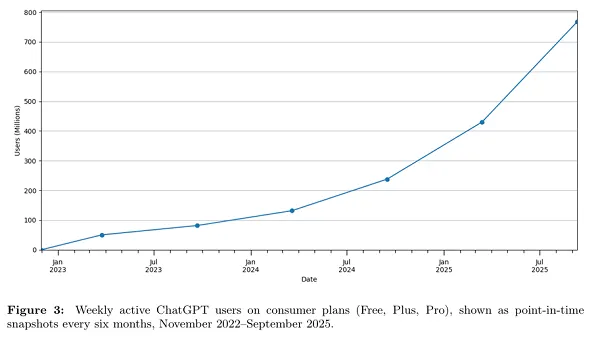
In July 2025, ChatGPT announced more than 700 million active users per week and transferred approximately 2.5 billion messages a day, or 18 billion messages weekly.
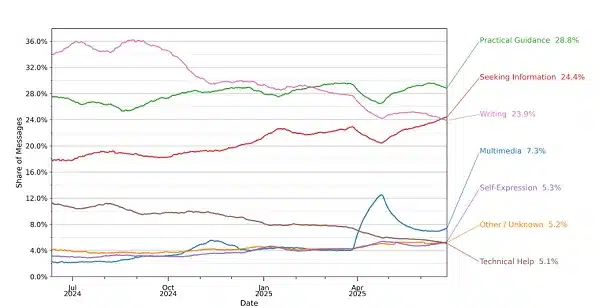
Users’ primary activities fall into three categories:
- Practical Guidance (29%)
- Seeking Information (24%)
- Writing (24%)
Writing-related use has slowed from 36% to just 24%. Seeking Information grew significantly, and suggests ChatGPT is gaining popularity as an alternative to traditional internet searches.
As per the report:
“The three most common Conversation Topics are Practical Guidance, Seeking Information, and Writing, collectively accounting for about 77% of all ChatGPT conversations. Practical Guidance has remained constant at roughly 29% of overall usage. Writing has declined from 36% of all usage in July 2024 to 24% a year later. Seeking Information has grown from 14% to 24% of all usage over the same period.”
The authors agree that ‘Seeking Information’:
“appears to be a very close substitute for web search.”
Asking, Doing, and Expressing Messages
The research categorizes user-generated messages based on intention:
- Asking: 49%
- Doing: 40%
- Expressing: 11%
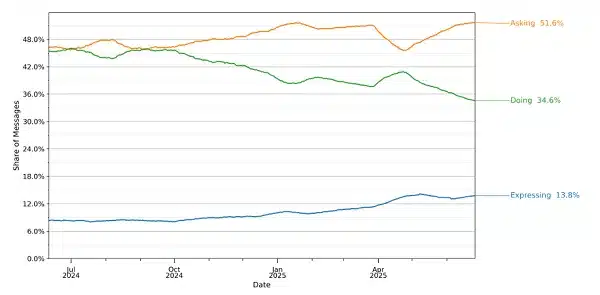
“Asking” messages are generally rated as being of higher quality according to algorithmic analysis and feedback from users.
Non-work-related ChatGPT usage jumped from 53% in June 2024 to 73% by June 2025.
Writing in the workplace is the most frequently used task, accounting for 40% of all work-related communications.
Education and tutoring account for 10% of the overall interactions.
Just 4.2% of chats are based on programming, while 1.9% relate to personal reflection or relationships, which suggests that these are the most minor but significant segments of ChatGPT use.
Global Adoption and Implications
The study shows the rapid growth of ChatGPT across the globe and gender gap reduction because users with a majority of feminine names increased from 37% to 52% in the period between January 2024 and July 2025.
In addition, growth in low-income countries surpasses that of higher-income regions by four times more and demonstrates the growing reach of ChatGPT. With more than a quarter of conversations being devoted to seeking out information, businesses must be ready for a change to AI-driven conversations.
Giving authoritative, accurate information that chatbots can’t duplicate will be crucial. The large portion of editing and writing shows how teams are seamlessly inscribing AI into workflows for content.
Adapting to AI-Driven Information Access
ChatGPT is rapidly becoming a leading site for online information discovery. It’s primarily personal use, more than 70%, suggesting broad changes in the habits of consumers that extend beyond professional ones.
To remain relevant, brands and content strategists have to be aware of AI adoption trends and adjust their strategies accordingly to reach out to audiences in which conversational AI plays a significant role.
Bottom Line
This study demonstrates ChatGPT’s growing influence on the consumption of information and the necessity of developing content strategies that encompass the AI-powered behavior of users.