All SEO
  SEO News
  SEO Strategy
  Ask An SEO
  Enterprise SEO
  Google Algorithm Updates
  International SEO
  Link Building
  Local SEO
  Mobile SEO
  On-Page SEO
  Technical SEO
  Vertical SEO
  Wordpress for SEO
  Web Dev for SEO
  SaaS SEO
  E-commerce SEO
  AI-Driven SEO
 Automattic’s SEO Claims Against WP Engine Under Scrutiny


Automattic’s SEO claims against WP Engine are under scrutiny as experts in the industry doubt the validity of the claims regarding WordPress performance.
Automattic’s recent legal counterclaim against WP Engine accuses the hosting company of using excessive SEO tactics specifically, overusing keywords like “WordPress” to manipulate search engine rankings. However, a more thorough examination suggests that the claims are based on outdated SEO notions and could be biased evidence.
Automattic Counter Claims
The counterclaim asserts WP Engine deliberately increased the frequency of WordPress trademarks mentioned on its website beginning around 2021 and 2022 with regard to WooCommerce.
The counterclaim suggests:
“WP Engine also has sown confusion in recent years by dramatically increasing the number of times Counterclaimants’ Marks appear on its websites. Starting in or around 2021, WP Engine began to sharply increase its use of the WordPress Marks, and starting in or around 2022, began to sharply increase its use of the WooCommerce Marks.”
Automattic next argues that the repetition of keywords on a web page is WP Engine’s SEO strategy. Here’s where their claims become controversial to those who know how search engines rank websites.
The counterclaim asserts:
“The increased number of appearances of the WordPress Marks on WP Engine’s website is particularly likely to cause confusion in the internet context.
On information and belief, internet search engines factor in the number of times a term appears in a website’s text in assessing the “relevance” of a website to the terms a user enters into the search engine when looking for websites.
WP Engine’s decision to increase the number of times the WordPress Marks appear on WP Engine’s website appears to be a conscious “search engine optimization” strategy to ensure that when internet users look for companies that offer services related to WordPress, they will be exposed to confusingly written and formatted links that take them to WP Engine’s sites rather than WordPress.org or WordPress.com.”
They call WP Engine’s strategy aggressive:
“WP Engine’s strategy included aggressive utilization of search engine optimization to use the WordPress and WooCommerce Marks extremely frequently and confuse consumers searching for authorized providers of WordPress and WooCommerce software;”
But, this notion is in opposition to the the current SEO best practices that are widely used within the industry.
Why the SEO Argument Is Outdated
Experts in SEO professionals as well as Google itself have made clear that the modern algorithms for search don’t rank websites solely on frequency of keyword.
Instead Google’s language models, such as BERT, study the user’s intent and content’s meaning, determining relevant content regardless of search terms used.
Google’s webpage on how search functions specifically states that the content is ranked according to user’s intentions, regardless of keywords. This is in direct contradiction to Automattic’s assertion regarding WPE’s SEO:
According to Google’s explanation:
“To return relevant results, we first need to establish what you’re looking for – the intent behind your query. To do this, we build language models to try to decipher how the relatively few words you enter into the search box match up to the most useful content available.
This involves steps as seemingly simple as recognizing and correcting spelling mistakes, and extends to our sophisticated synonym system that allows us to find relevant documents even if they don’t contain the exact words you used.”
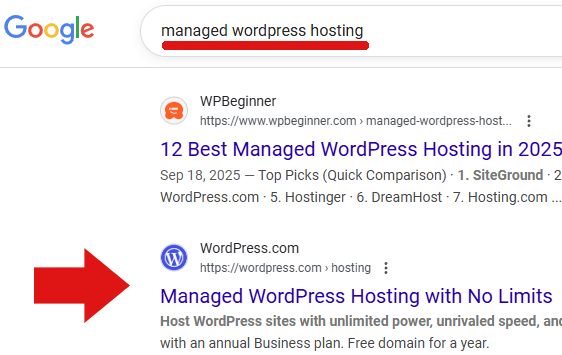
Furthermore, WordPress.com ranks highly for “Managed WordPress Hosting” despite not being able to match the search term on its site, proving the fact that density of keywords isn’t solely a ranking factor.
Screenshot Of WordPress.com In Search Results
Screenshot Of Graph
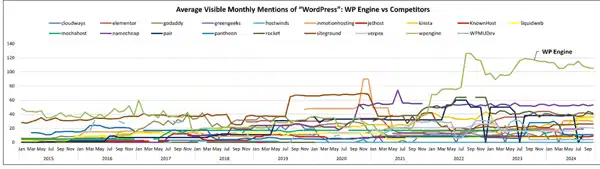
This is a close-up of the graph (with the data included) which shows the daily mentions in the month of “WordPress” far exceed the quantity of times that words containing WordPress are utilized on the pages of other hosts.
Screenshot Of Graph Closeup
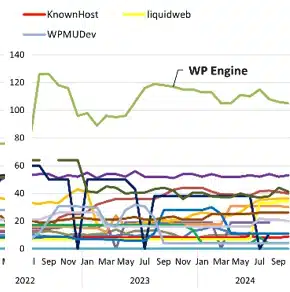
The saying goes that numbers don’t lie and this graph provides convincing proof of the fact that WP Engine is deploying an intensive use of keywords with an asterisk WordPress in their.
While we leave aside the disputed notion that keyword-term spamming is effective however, a closer examination of the graph analysis indicates that the evidence isn’t as strong due to the fact that it is biased.
Bias in the Comparison Group
A closer examination reveals that the majority of host companies compared are generalist hosts with a wide range of services (e.g. dedicated servers, VPS or domain registration) and, consequently, result in less mentions of “WordPress” across their broader websites.
This can cause a bias towards WP Engine, a managed WordPress host that is focused on one specific niche.
In the host category that are listed, there are only 5 hosts (including WP Engine) specialize in managed WordPress hosting as well as only two of them Kinsta and Rocket.net are genuine direct rivals. Comparatives that are limited to these hosts produce different results.
Comparison Of WordPress Hosts
Automattic analyzes monthly searches for phrases that have “WordPress” in them, and it’s evident that the choice of host in the comparison can bias the results towards WP Engine. An objective way to compare is to look at the most popular webpage for the term “managed WordPress hosting.”
The following is a review of the most popular web pages on each of three WordPress hosts on Automattic’s comparison lists an easy one-to-one comparability.
I utilized the phrase “managed WordPress hosting” plus the domain name that was added to an internet search query to identify the top-ranked website on each site and looked at the number of times the term “WordPress” is used on the pages.
These are the result:
Rocket.net
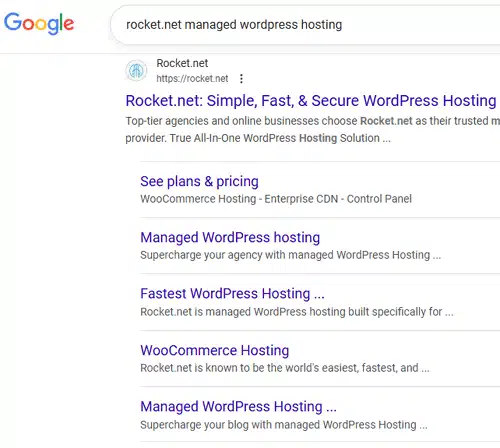
The homepage of Rocket.net is the top page for “WordPress Hosting” and “rocket.net managed wordpress hosting.” The homepage of Rocket.net has”WordPress” 21 times.
Screenshot of Google’s Search Results
Kinsta
The top ranked Kinsta page is kinsta.com/wordpress-hosting/ and that page mentions the word “WordPress” 55 times.
WP Engine
The top ranked WP Engine web page is wpengine.com/managed-wordpress-hosting/ and that page mentions the word “WordPress” 27 times.
A fair one-to-one analysis of managed WordPress hosting providers, compiled from Automattic’s list, confirms how WP Engine is not using the term “WordPress” more often than its rivals. Its usage is right within the middle of a fair one-to-1 comparison.
Number Of Times Page Mentions WordPress
- Rocket.net-21 times
- WP Engine-27 times
- Kinsta-55 times
Other Managed WordPress Hosts
To make a comparison, I looked at five other managed WordPress hosts which Automattic did not include in its analysis to find out how often “WordPress” was mentioned on the web pages that rank highest on WP Engine’s closest competitors.
The results are:
- WPX Hosting-9
- Flywheel-16
- InstaWP-22
- Pressable-23
- Pagely-28
It’s evident that the 27 mentions of WP Engine are at or near the top range of that comparison however, it’s not at the same level as Kinsta’s makes mention of “WordPress.” So far we’ve only seen a small portion of the picture.
As you can see, many web hosts make use of the term “WordPress” far more than Kinsta does, so it’s unlikely to be an exception when compared to the general web hosting providers.
A Comparison With Generalist Web Hosts
The next step is to compare the generalist web hosting providers listed on Automattic’s list of comparison sites.
I ran the same kind of search on generalist web hosting providers to reveal their top pages on the phrase “managed WordPress hosting” plus the name of the site that is a one-to-one contrast against WP Engine.
Other Web Hosts Compared To WP Engine:
- InMotion Hosting-101 times
- Greengeeks-97 times
- Jethost -7 times
- Verpex-52 times
- GoDaddy-49 times
- Cloudways-47 times
- Namecheap-41 times
- Liquidweb-40 times
- Pair-40 times
- Hostwinds-37 times
- KnownHost-33 times
- Mochahost-33 times
- Panthen-31 times
- Siteground-30 times
- WP Engine-27 times
Crazy, right? WP Engine uses the word “WordPress” less often than any different generalist website hosts. This is a one-to-one contrast to Automattic’s graph.
And just for the record, WordPress.com’s top-ranked page wordpress.com/hosting/ uses the word “WordPress” 62 times, over twice as often as WP Engine’s web page.
Will Automattic’s SEO Claims Be Proven False?
Automattic’s claims regarding WordPress Engine’s use of SEO could be based on weak foundations. The assertions about the way that keywords are used in SEO are in contradiction to Google’s own documentation.
Also, an observation that WordPress.com’s own site ranks in the search results for “Managed WordPress Hosting” despite not using the exact term. This seems to contradict their claim that search engines consider the frequency with which the user’s keywords are mentioned on a website.
The graph Automattic provides in their counterclaim doesn’t provide a direct comparison of competitors, which could lead to the false perception of WP Engine is aggressively using the “WordPress” keywords more often than its competitors.
A one-to-one analysis of the actual websites that compete with the term “Managed WordPress Hosting” shows that a majority of the websites on Automattic’s list utilize the term “WordPress” far more often than WP Engine, which directly is in contradicts Automattic’s claim.
Bottom Line
Automattic’s SEO accusations appear to rest on an outdated understanding of search engine behavior and selectively biased data.